

What Is the Difference Between Signage and Wayfinding?
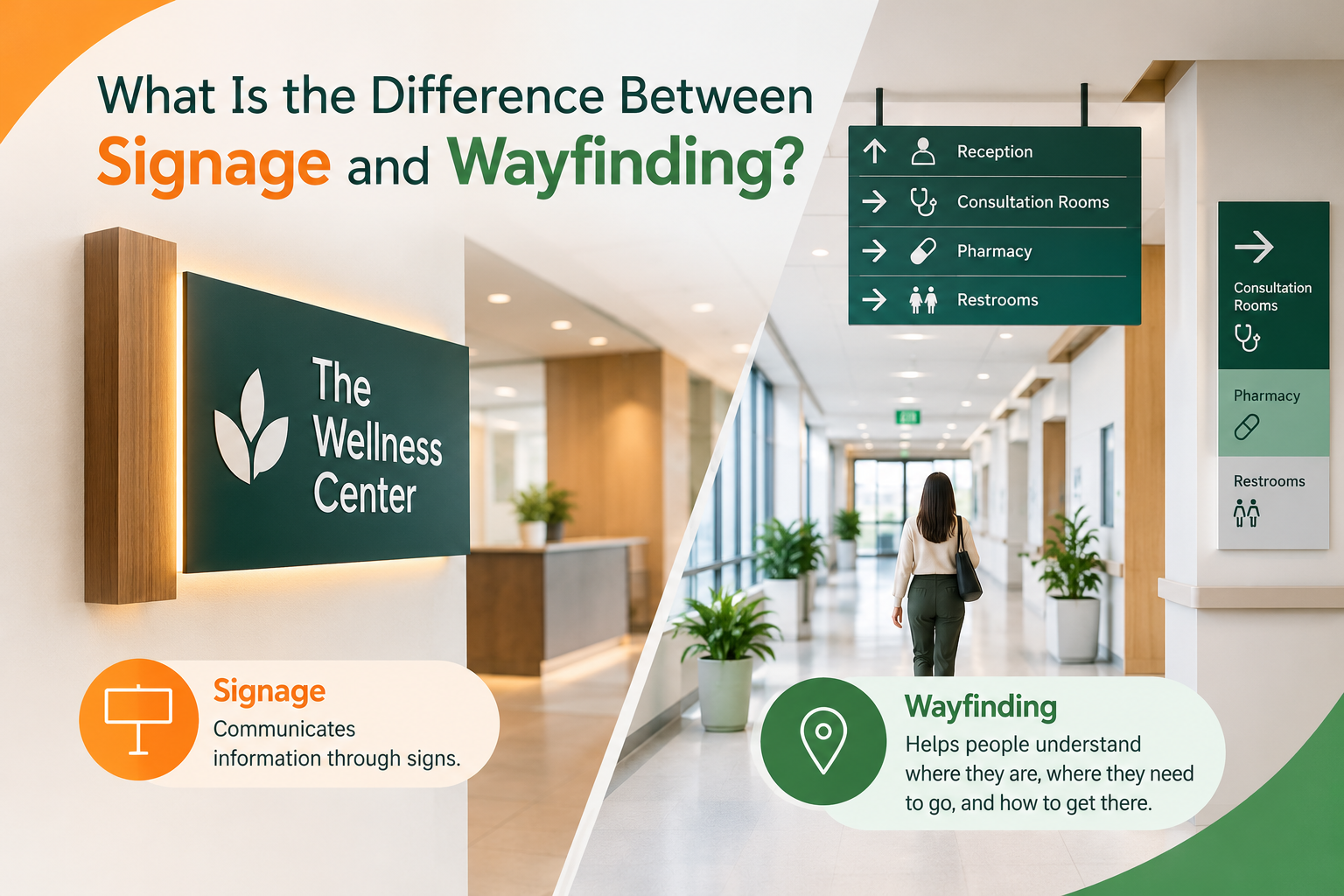
Signage and wayfinding are closely related, but they serve different purposes. Signage communicates information through signs, while wayfinding helps people understand their surroundings and navigate from one location to another. Both are important in commercial buildings, hospitals, hotels, shopping centres, educational institutions, and public spaces.
For example, a sign displaying a meeting room number identifies the room. A wayfinding system helps a visitor travel from the building entrance to that meeting room using directories, directional signs, maps, and other navigation cues.
Although signage is often a part of wayfinding, the two terms are not interchangeable. Understanding the difference helps explain how people interpret information, navigate unfamiliar environments, and find destinations efficiently.
What Is Signage?
Signage refers to visual communication elements designed to display information, identify locations, communicate instructions, promote a brand, or guide people through an environment. Professional signage services help businesses create effective signage solutions that combine clear communication, brand identity, and functional design.
Signs can be installed on building exteriors, reception walls, office doors, corridors, parking areas, retail spaces, and public facilities. They may communicate a simple message, such as a room number, or provide more detailed information about a building's facilities and services.
Common signage formats include printed panels, dimensional lettering, illuminated signs, directional signs, building directories, and digital displays.
What Are the Main Types of Signage?
Signage can be classified according to the information it communicates and the purpose it serves.
Identification Signage
Identification signs indicate the name or purpose of a particular place. Examples include building name signs, office nameplates, meeting room signs, and department identification signs.
Directional Signage
Directional signs help people identify which direction to follow to reach a destination. They commonly use arrows, text, and symbols to communicate routes.
Informational Signage
Informational signs provide details that help people understand a location or service. Examples include opening hours, visitor instructions, facility information, and floor directories.
Safety and Regulatory Signage
These signs communicate warnings, restrictions, mandatory instructions, or emergency information. Examples include fire exit signs, hazard warnings, and restricted-access notices. Their design and placement may be governed by applicable safety regulations.
Architectural Signage
Architectural signage combines identification or informational functions with the design of the surrounding building. It may incorporate dimensional lettering, metal panels, integrated lighting, and materials selected to complement the architecture.
Promotional and Branding Signage
Promotional signs communicate a business's identity, products, services, or campaigns. Storefront signs, branded displays, and retail promotional panels are common examples.
Each type of signage serves a particular purpose. Some signs communicate a single piece of information, while others form part of a larger system that helps people navigate an environment.
What Is Wayfinding?
Wayfinding is the process of helping people understand their surroundings and navigate from one location to another. Professional wayfinding services help businesses, architects, and property developers plan effective navigation systems using visual information, spatial planning, landmarks, maps, directional signs, and consistent design elements.
A wayfinding system brings these elements together to help people navigate a building, campus, public space, or other environment.
Consider someone visiting a hospital for the first time. The visitor may need to locate the main entrance, find the registration desk, identify the correct department, and reach a consultation room. A well-organized wayfinding system helps connect these steps into a clear journey.
Wayfinding is not limited to reading signs. People also use architectural features, landmarks, maps, floor layouts, familiar symbols, and their understanding of the surrounding space.
What Are the Main Elements of a Wayfinding System?
An effective wayfinding system may include the following elements:
Directional Signs
Indicate which route to follow.
Identification Signs
Confirm the name or location of a destination.
Directories and Maps
Show the arrangement of buildings, floors, departments, or facilities.
Colour Coding
Helps distinguish different zones, routes, or departments.
Symbols and Icons
Communicate information through recognizable visual representations.
Landmarks
Provide reference points that help people understand where they are.
Digital Navigation
Uses interactive maps, digital directories, or navigation tools where appropriate.
Consistent Visual Design
Helps users recognize related information throughout an environment.
These elements work together to support navigation. Their effectiveness depends on the building layout, sign placement, visibility, consistency, and the needs of the people using the space.
Signage vs. Wayfinding: What Is the Difference?
The primary difference between signage and wayfinding is their purpose and scope.
Signage is a form of visual communication that conveys specific information. Wayfinding is a broader process that helps people understand their location, make navigation decisions, and reach their destination.
| Comparison | Signage | Wayfinding |
|---|---|---|
| Definition | Visual communication through signs | The process of navigating an environment |
| Primary purpose | Communicates information or identifies a location | Helps people understand where to go |
| Scope | Can involve a single sign or multiple signs | Considers the complete journey through a space |
| Main components | Text, symbols, graphics, lettering, and displays | Signs, maps, landmarks, spatial layout, and navigation cues |
| Planning focus | Message clarity, visibility, materials, and placement | Routes, decision points, destinations, and user movement |
| Common examples | Room signs, building signs, and informational panels | Hospital navigation, campus maps, and building navigation systems |
| Success measures | Readability, visibility, and message comprehension | Ease of navigation and the ability to reach destinations |
Example: Signage and Wayfinding in an Office Building
Imagine a visitor attending a meeting on the sixth floor of a commercial office building.
The building entrance sign identifies the property. A reception sign identifies the welcome desk, while a directory lists the businesses and departments located on different floors.
Directional signs indicate the route to the lifts. Once the visitor reaches the sixth floor, floor identification and corridor signs help them locate the correct area. Finally, a meeting room sign confirms the destination.
Each sign communicates specific information, but the complete sequence supports the visitor's journey.
This illustrates the relationship between the two concepts: signage provides information, while wayfinding organizes information and navigation cues to help people reach their destination.
How Do Signage and Wayfinding Work Together?
Signage and wayfinding are most effective when they are considered complementary parts of the same environment.
A sign may be easy to read but still be ineffective if it is placed where people cannot see it before making a navigation decision. Similarly, a building may have an understandable layout, but visitors may struggle if important destinations are not clearly identified.
Combining clear signs with logical routes and consistent navigation information helps address these problems.
Consistent Information
Destination names should remain consistent across directories, directional signs, maps, and room identification signs. For example, if a directory lists a destination as "Conference Centre" but directional signs call it "Meeting Hall," visitors may wonder whether these names refer to the same place. Consistent terminology reduces uncertainty.
Clear Directional Information
People often need directions at specific points, such as entrances, corridor intersections, lift lobbies, and stairwells. Placing relevant directional information before these decision points gives users more time to identify the correct route.
Recognizable Visual Cues
Consistent colours, symbols, typography, and sign layouts help users recognize related information throughout a building. Colour coding can distinguish floors or departments, but it should be combined with text and symbols rather than used as the only navigation cue.
Logical Navigation Routes
Wayfinding should reflect how people actually move through an environment. A route that appears straightforward on a floor plan may become confusing if signs are hidden, corridors look similar, or important destinations are not identified at the right locations. Understanding user movement is therefore an important part of effective wayfinding.
Why Are Signage and Wayfinding Important?
Both signage and wayfinding contribute to how people understand and use a physical environment. Their importance becomes particularly clear in buildings with multiple destinations, unfamiliar layouts, or high visitor traffic.
Improve the Visitor Experience
Clear signage helps visitors identify rooms, facilities, departments, and entrances. A coordinated wayfinding system helps them connect this information and understand where to go next. This is particularly valuable in unfamiliar environments where visitors may not know the building layout.
Support Accessibility and Inclusion
People have different visual, physical, and cognitive needs. Clear information and predictable navigation can make environments easier to use.
Depending on the setting and applicable standards, accessible signage and wayfinding may incorporate:
- Readable text and appropriate colour contrast.
- Clear arrows and recognizable symbols.
- Consistent sign placement.
- Tactile information and Braille where required.
- Information about accessible routes.
- Alternative navigation options where appropriate.
Important information should not rely on colour alone, as some users may have difficulty distinguishing particular colours.
Reduce Navigation Confusion
In large buildings, people may encounter multiple corridors, floors, entrances, and departments. A coordinated wayfinding system helps organize information around important decision points. This can reduce uncertainty and make routes easier to understand.
Support Building Operations
Clear identification and directional information can help employees, visitors, contractors, and delivery personnel locate the correct areas. In environments such as hospitals, educational campuses, and commercial complexes, this can help people move through the space more efficiently.
Maintain Visual Consistency
Signage also contributes to the overall appearance of a building. Consistent typography, colours, materials, and finishes can create a cohesive visual identity while helping people recognize related signs across different areas.
Where Are Signage and Wayfinding Used?
The requirements for signage and wayfinding vary according to the environment, its users, and the complexity of its layout.
Commercial Buildings and Corporate Offices
Commercial buildings commonly use entrance signs, tenant directories, reception signs, floor identification, meeting room signs, and directional information. Individual signs identify locations, while the wider wayfinding system helps visitors move between entrances, lifts, offices, meeting rooms, and shared facilities.
Hospitals and Healthcare Facilities
Hospitals can be difficult to navigate because they contain multiple departments, diagnostic facilities, treatment areas, waiting rooms, and restricted zones. A coordinated wayfinding system connects identification and directional signs with floor directories, maps, and accessible routes. Healthcare environments require particular attention to readability, accessibility, and consistent terminology.
Hotels and Hospitality Spaces
Hotels use signs to identify entrances, reception areas, guest rooms, restaurants, meeting spaces, lifts, and amenities. Wayfinding helps guests move between these destinations, while identification signs confirm that they have reached the correct location. The visual design should complement the hospitality environment without compromising clarity.
Shopping Centres and Retail Environments
Shopping centres often contain several floors, entrances, retail units, restaurants, parking areas, and customer facilities. Directories and maps show where stores are located, while directional signs guide visitors towards specific destinations. Larger centres may also use digital directories or interactive maps.
Educational Institutions and Campuses
Schools, universities, and campuses may include multiple buildings, classrooms, libraries, administrative departments, sports facilities, and parking areas. Building identification signs help people recognize individual facilities, while campus maps and directional signs help them travel between destinations.
Public Buildings and Transport Facilities
Airports, railway stations, civic buildings, and other public facilities need to communicate information to people who may be unfamiliar with the environment. These settings often require coordinated signs, maps, symbols, and multilingual information to support navigation.
How to Determine Whether You Need Signage or Wayfinding
The right approach depends on the communication or navigation problem that needs to be addressed.
When Is Signage Enough?
Individual signage may be sufficient when the main requirement is to communicate a specific message or identify a location. Examples include:
- Displaying a business name at an entrance.
- Identifying an office or meeting room.
- Showing opening hours or visitor instructions.
- Identifying a particular department.
- Communicating a safety warning.
In these cases, the sign's primary purpose is to make information clear and easy to understand.
When Is a Wayfinding System Necessary?
A broader wayfinding approach is useful when people need to follow a route through several areas or make multiple navigation decisions. Examples include:
- Finding departments across different hospital floors.
- Navigating a large commercial building.
- Locating stores within a shopping centre.
- Moving between buildings on a university campus.
- Finding facilities throughout a hotel or conference centre.
In these environments, individual signs need to work together as part of a consistent navigation system.
When Are Both Needed?
Most large commercial and public environments benefit from both signage and wayfinding.
A new office building, for example, may require exterior building identification, reception signs, floor directories, room signs, and directional information. Each sign has its own function, but all contribute to the overall experience of navigating the building.
The important consideration is not simply how many signs are installed, but whether the information is clear, consistent, and available where people need it.
Frequently Asked Questions
What is the main difference between signage and wayfinding?
Signage communicates information through signs, such as building names, room numbers, instructions, and directions. Wayfinding is the broader process of helping people navigate an environment using signage, maps, landmarks, spatial information, and other navigation cues.
Is wayfinding a type of signage?
No. Wayfinding is a broader navigation process that often uses signage as one of its main tools. It can also include maps, landmarks, spatial planning, digital navigation, and consistent visual cues.
What are the main types of signage?
Common types include identification signage, directional signage, informational signage, safety and regulatory signage, architectural signage, and promotional signage. Each type serves a different communication purpose.
What are the main elements of a wayfinding system?
A wayfinding system may include directional signs, identification signs, directories, maps, colour coding, symbols, landmarks, and digital navigation tools. The elements used depend on the size, layout, and purpose of the environment.
Why is wayfinding important in commercial buildings?
Wayfinding helps visitors and employees locate entrances, offices, meeting rooms, facilities, and other destinations. A coordinated system makes navigation easier, particularly in buildings with several floors, departments, or entrances.
How is architectural signage different from wayfinding?
Architectural signage integrates signs with a building's design while communicating identification or other information. Wayfinding focuses on helping people navigate an environment. Architectural signage can form part of a wayfinding system when it helps users identify locations or follow routes.
How can signage and wayfinding improve accessibility?
They can support accessibility through readable text, sufficient contrast, recognizable symbols, consistent placement, tactile information, Braille where required, and accessible route information. The appropriate features depend on the environment and applicable accessibility standards.
What should be considered when planning a wayfinding system?
Important considerations include the building layout, user needs, destination names, navigation routes, sign placement, visibility, accessibility, and consistency. Testing the system with people unfamiliar with the building can help identify confusing directions or missing information.
Conclusion
Signage and wayfinding are closely connected, but they serve different purposes. Signage communicates specific information, identifies locations, and provides instructions. Wayfinding brings information and navigation cues together to help people understand their surroundings and reach their destinations.
A single room sign may be enough to identify an office, but navigating a large hospital, shopping centre, or commercial building requires a more coordinated approach.
Understanding this distinction helps businesses, architects, designers, and property managers make better decisions about visual communication and navigation. By considering how people interpret information and move through a space, it becomes easier to create environments that are understandable, accessible, and easier to navigate.
