

How Color-Coded Wayfinding Reduces Patient Confusion
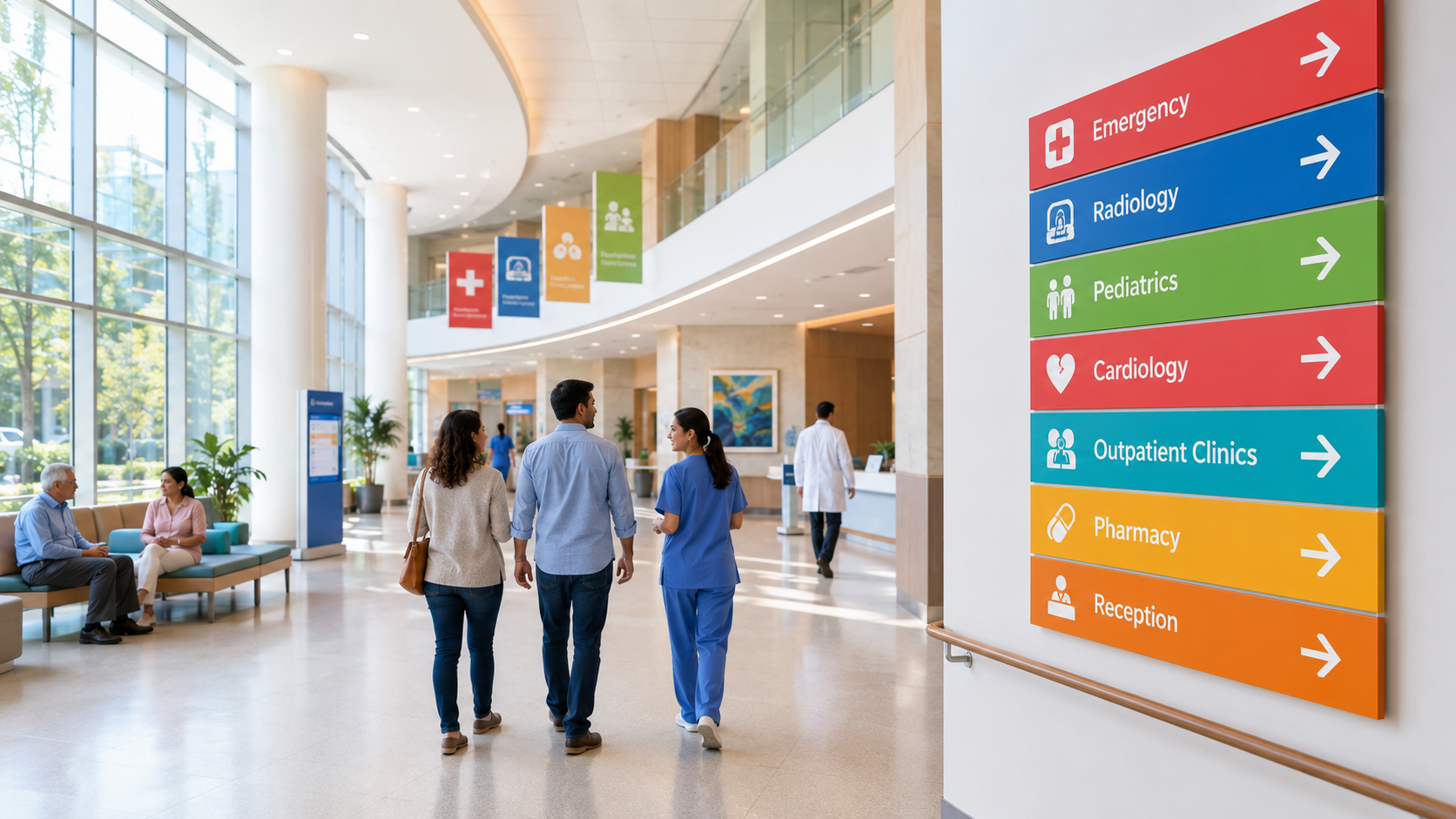
Walking into a hospital for the first time can feel disorienting. Long corridors, multiple departments, and complex building layouts often make it difficult for patients and visitors to find their destinations. This is where colour-coded wayfinding makes a measurable difference. A well-designed navigation system, including directional signage, maps, and colour-coded wayfinding, reduces confusion, minimises delays, and lowers stress. Hospitals can guide patients and visitors from the entrance to their destination without confusion or unnecessary stress.
What Is Wayfinding in Healthcare?
Wayfinding in healthcare refers to the systems and design strategies used to help patients, visitors, and staff navigate healthcare facilities easily and efficiently. Wayfinding helps people orient themselves and move confidently through a physical environment. A well-designed wayfinding system goes beyond simply placing directional signs. It creates an intuitive navigation experience through consistent visual cues people can recognise.
Without a clear wayfinding system, navigating these spaces can become stressful, especially for first-time visitors, elderly individuals, children, or people with disabilities. Wayfinding improves the overall patient experience while allowing healthcare professionals to focus more on patient care rather than on giving directions.
Why Navigation Matters in a Hospital
For most people, a hospital visit doesn't begin with the appointment itself: it begins with finding their way there. Patients and visitors may need to travel between registration areas, diagnostic centres, outpatient clinics, laboratories, pharmacies, and treatment rooms during a single visit. Without clear navigation, finding the right destination can become confusing, stressful, and time-consuming. Navigation plays a vital role in creating a positive healthcare experience.
Effective hospital navigation ensures that people can move through the facility safely and efficiently while reducing anxiety and improving overall satisfaction. It is important because many patients arrive feeling unwell, anxious, or under emotional strain. Poor navigation carries consequences that go beyond how a patient feels. A patient arriving late because they couldn't find the right department can create a ripple effect, delaying every appointment scheduled after them that day; that's why navigation matters in a hospital.
Navigation plays a quiet but meaningful role in patient outcomes. Patients who arrive calm and oriented, rather than frazzled from getting lost, tend to communicate more effectively with their care team.
What Is Color-Coded Wayfinding?
Colour-coded wayfinding is a navigation strategy that uses easy-to-read colours to identify different areas, departments, floors, or routes within a building. navigation approach that uses specific colours for different zones, departments, floors, or paths within a facility. For example, a hospital might assign blue to the Outpatient Department, green to Diagnostic Imaging, red to the Emergency Department, and yellow to Maternity Services. Colour acts as a kind of visual shorthand, standing in for more complex directional information.
What sets colour-coded wayfinding apart from general signage is how quickly and universally it communicates. Colour is processed by the brain faster than text, making it easier to recognise. Because the same colours appear throughout the building, visitors quickly learn to associate a particular colour with their destination, making navigation faster and more intuitive.
The Science Behind Color-Coded Wayfinding
Colour-coded wayfinding is based on how people think about colours, how much they can handle, and how things are designed. People can look at colours. Understand them really fast, which is why colours are so good at helping people get around places that are hard to navigate.
Colour Psychology and Perception
Different colours make people feel different ways. Colours affect how people think about the place they're in and how they get around. Our brain can see colours away, usually before we can read words or symbols. When colours are used in a hospital, they become like landmarks that help visitors find their way around.
Cognitive Load Reduction
One of the things about colour coding is that it does not make people think too much. Colour coding means people do not have to remember a lot of things. Instead of trying to remember many steps, visitors just need to remember one colour and follow it. This makes it easier for people to get around, and they do not get confused.
Why Colour Improves Recognition Over Text Alone
People can see colours and shapes fast. Reading takes time because we have to look at each letter and then understand what it means. Colours are easy to understand. When we use colours with signs and symbols, it is easier for people to get around.
Colour Strengthens Spatial Memory
Colours help people remember where they are. Our brain is good at remembering places and getting around. Colours are like landmarks that help us remember how to get around a place. After a while, visitors know the hospital well and can get around easily. They are not confused. They can find what they need. Colour-coded wayfinding is a system because colour helps people remember the hospital layout and navigate.
How Color-Coded Wayfinding Supports Patient-Centred Care
A patient-centred healthcare environment focuses on making every patient feel safe, respected, informed, and confident throughout their healthcare journey. Navigation plays a bigger role in that experience than many people realise. Colour-coded wayfinding directly supports this philosophy by addressing patients' emotional, practical, and psychological needs as they move through a hospital.
Reducing Patient Stress and Anxiety
Hospitals can be overwhelming, especially for first-time visitors, older adults, or patients seeking urgent care. Colour-coded signage simplifies navigation, making it easier to find the right destination with confidence.
Enhancing Patient Independence and Dignity
Colour-coded wayfinding empowers patients by making navigation easier for them to find their way. Instead of depending on verbal instructions, they can confidently follow colour-coded signs, walls, floor paths, or door markers to reach their destination.
Creates a More Inclusive Healthcare Environment
Colour-coded wayfinding supports inclusivity by providing a universal visual language that complements written information. Colours can be recognised much faster than text and are often easier to understand regardless of language proficiency.
Builds Trust Through a Better Patient Experience
Navigation is often a patient's first impression of a hospital. This often translates into higher patient satisfaction and a stronger perception of care quality. A hospital that feels easy to move through subtly signals organisation and competence.
Benefits of Color-Coded Wayfinding for Healthcare Facilities
Colour-coded wayfinding delivers measurable benefits at the facility level, improving patient flow, reducing confusion, and improving response safety measures.
Improves Patient Flow and Operational Efficiency
When patients and visitors can navigate independently, the entire facility runs more smoothly. It helps patients reach their appointments on time. With fewer people stopping to ask for directions, healthcare staff can focus more on patient care, improving overall operational efficiency.
Reduced Patient and Visitor Confusion
Colour-coded signage provides clear visual guidance, making it easier to identify departments, clinics, and service areas. This reduces confusion, minimises missed appointments, and creates a positive experience for patients and their families.
Improved Safety and Emergency Response
Colour-coded wayfinding helps patients, visitors, and emergency responders. Clear visual cues support quick decision-making, improve navigation during serious situations, and contribute to a safer healthcare environment.
Supports Patient Safety
Accurate navigation is an important part of patient safety. Colour-coded wayfinding is really important for patients when they are moving around the building. It helps reduce stress and physical strain and improve overall safety within the healthcare facility.
Supports Digital and Smart Hospital Navigation
Colour-coded wayfinding integrates seamlessly with digital maps, mobile apps, and interactive kiosks. Digital platforms create a consistent navigation experience, helping patients reach their destinations more easily and confidently.
Key Principles of Effective Color-Coded Wayfinding
A colour-coded system is only as effective as its design. The real impact comes from following a set of core principles that keep the system clear, consistent, and useful for the people relying on it.
Create a Clear and Logical Colour System
Each colour should also be visually distinct enough to avoid confusion, especially under varying lighting conditions or for patients with limited colour vision. A limited colour palette makes the system easier to understand and remember.
Choose a Logical Color-to-Department Mapping System
How colours are assigned to departments matters just as much as the colours themselves. Map colours to departments in a way that feels intuitive. A logical colour association helps patients recognise and recall their routes more easily.
Combine Colours with Text, Icons, and Symbols
Colour should never be the only tool doing the work. Pair colour-coded signage with clear text, universally recognised icons, and directional arrows to ensure accessibility for people with colour vision deficiencies, language barriers, or visual weakness.
Use Colour Strategically in High-Confusion Areas
Not every part of a hospital needs the same level of visual reinforcement, but some locations where navigation decisions are most critical, such as entrances, reception areas, elevators, corridors, stairwells, and major intersections, are key decision points that help users stay on the correct path throughout their journey.
Ensure Consistency Across All Touchpoints
Use the same colour system across every navigation element. Consistency reinforces recognition, reduces confusion, and creates a seamless navigation experience throughout the healthcare facility.
Common Mistakes to Avoid
Using too many colors
Using too many colours can overwhelm users and make the wayfinding system confusing. Use a limited number of distinct colours that are easy to recognise and apply consistently throughout the facility.
Choosing colours that are too similar
Selecting two shades of the same colour creates confusion rather than clarity, especially under inconsistent lighting or for patients with colour vision deficiencies. Select colours with strong visual contrast so that each department or zone is immediately identifiable.
Poor contrast choices
Even the best colour system can fail if signs are difficult to read. Low contrast between text, symbols, and backgrounds reduces visibility. Use high-contrast combinations, large fonts, and clear graphics to ensure signage remains readable in all lighting conditions.
Digital-physical mismatch
Many hospitals now use digital maps, mobile apps, and self-service kiosks alongside physical signage. Maintaining consistent colour schemes across both digital and physical wayfinding ensures a seamless navigation experience and reduces patient confusion.
No documented style guide
Without a documented wayfinding style guide, future renovations or different departments may introduce inconsistent colours, fonts, icons, and signage, gradually weakening the system's visual consistency and unity.
Assuming universal colour meanings
Colours may have different meanings across cultures, so they should not be the only navigation cue. Combine colour coding with clear text, universal icons, directional arrows, and accessible design features to create an inclusive wayfinding system.
Future Trends in Healthcare Wayfinding Design
Healthcare wayfinding is evolving beyond traditional signage, combining colour-coded systems with smart technologies to enable more efficient navigation. Understanding these emerging trends helps healthcare facilities create future-ready wayfinding systems that remain effective over time.
Mobile app-based navigation
Many hospitals now use mobile apps with turn-by-turn indoor navigation to complement colour-coded signage and simplify navigation for patients and visitors.
Interactive digital kiosks
Interactive digital kiosks are replacing traditional information desks in many healthcare facilities. These touch-screen displays provide instant access to hospital maps, department and physician locations, or appointment information.
Real-Time Location and Personalisation
Using tools like Bluetooth beacons or Wi-Fi triangulation, it is starting to bring GPS-like functionality indoors. This allows systems to personalise navigation based on a patient's actual appointment data
AI-optimized wayfinding layouts
By identifying areas where patients commonly become confused, AI helps hospitals redesign pathways, improve colour zoning, relocate signs, and simplify navigation.
Chatbot and voice-assistant integration
For patients who prefer speaking over reading, voice-guided navigation is emerging as a natural extension of digital wayfinding tools.
Sensory-adaptive signage
Sensory-adaptive design ensures that every patient, regardless of age or ability, can navigate healthcare facilities safely and independently.
FAQ
What is the colour-coded wayfinding system in healthcare settings?
The colour-coded wayfinding system in healthcare uses colours to identify the various hospital departments or zones. This makes it a lot easier for patients, visitors, and staff to find their way.
How does the colour-coded wayfinding system help reduce confusion for patients?
The colour-coded wayfinding system provides people with signs to follow. These signs help people find where they need to go. This means they are less likely to get lost.
Why is wayfinding so important in hospitals like these?
Wayfinding in hospitals helps people navigate. It reduces the time people wait around. It also makes the hospital a safer place. It helps make the hospital a more organised and efficient place to be.
How does wayfinding affect the experience of patients in healthcare?
Wayfinding helps reduce the stress that patients feel. It saves them time. It also helps patients navigate the hospital with confidence and ease. Patients feel better when they can find their way around the hospital easily.
What does the future hold for wayfinding in healthcare settings like hospitals?
The future of wayfinding in healthcare is changing. Now we have maps and mobile apps and QR codes and navigation that uses artificial intelligence. These new tools provide people with guidance that is just for them. The colour-coded wayfinding system in healthcare is still. Now we have these new tools to help people find their way around.
Conclusion
Colour-coded wayfinding is a simple yet highly effective solution for reducing patient confusion and improving navigation in healthcare facilities. By using consistent colours, clear signage, and accessible design, hospitals can create a more intuitive environment that reduces stress, saves time, and enhances the overall patient experience. As healthcare facilities continue to adopt digital navigation tools and smart technologies, maintaining a unified and well-planned colour-coded wayfinding system will remain essential for delivering seamless, efficient, and patient-centred care.
