

Digital Signage vs. Traditional Signage in The UAE: The Complete Comparison Guide
TL;DR
Digital and traditional signage serve different purposes in UAE business spaces
Traditional signage is best for fixed, regulatory, and permanent information
Digital signage works best in high-traffic areas that need real-time updates and higher engagement
UAE businesses are increasingly adopting digital signage to support smart buildings, sustainability, and better ROI
Most commercial spaces perform best with a hybrid approach that combines both signage types
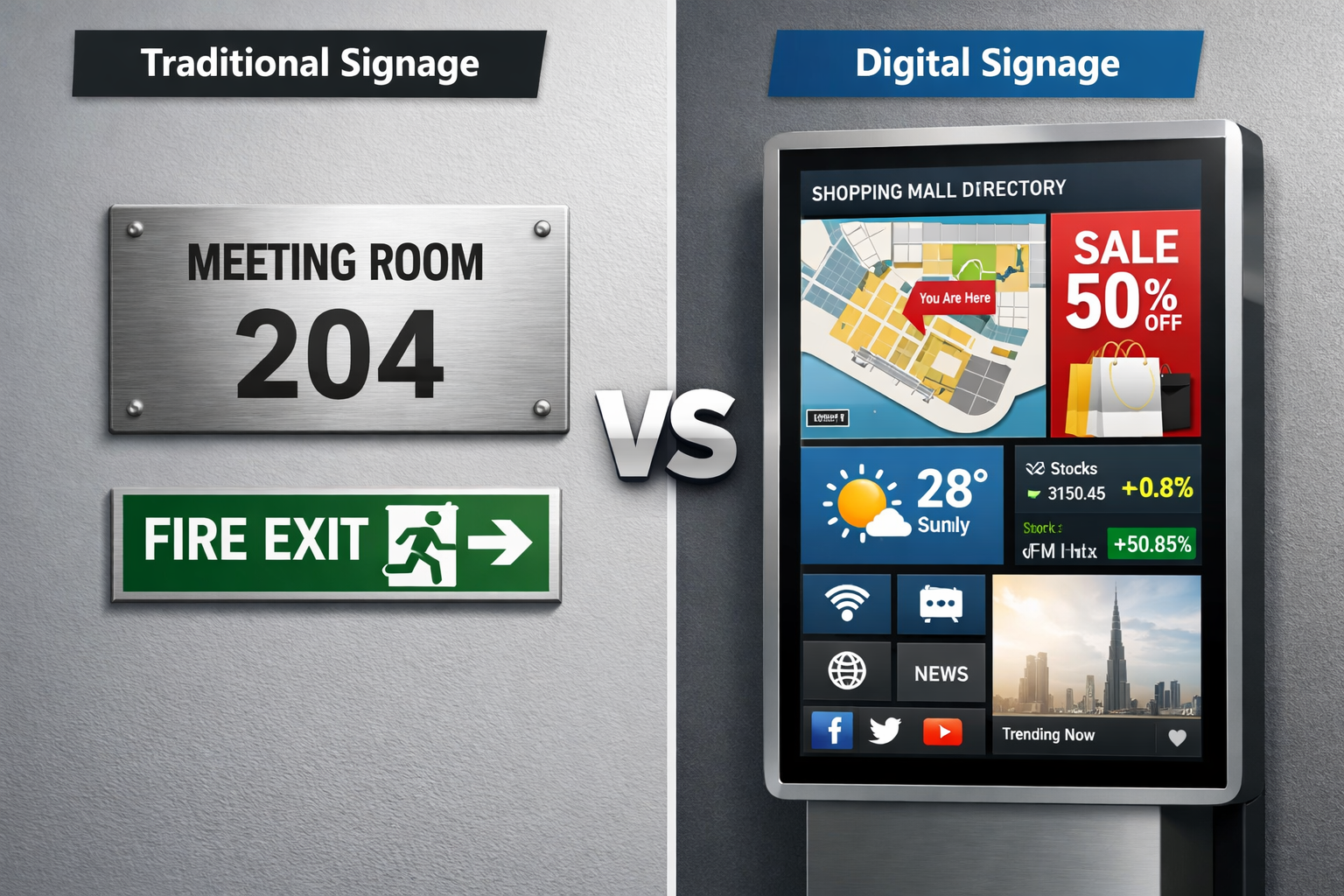
In a country defined by world-class architecture, signage is no longer just about pointing the way, it is about defining the experience.
Many organisations now rely on expert wayfinding & signage consultants to create visitor-friendly, future-ready environments.
For property managers in Dubai and Abu Dhabi, the choice between traditional signage and digital signage is the difference between a building that functions and one that performs.
This guide compares the two technologies, analyzes the ROI for UAE businesses, and aligns your strategy with UAE Vision 2030.
Traditional Signage vs Digital Signage: What is the Difference?
The main difference between digital signage and traditional signage lies in how information is displayed and updated.
What Is Traditional Signage?
Traditional signage, also known as static signage, refers to non-digital displays such as:
Printed posters and banners
Engraved metal or acrylic signs
Vinyl graphics
Lightboxes
Fixed directional and safety signage
These traditional signs are designed for permanent or long-term information that is static and that does not change frequently, such as room numbers, exits, compliance notices, and building identification.
Many of these signs also form part of a larger wayfinding system that helps visitors navigate complex environments. Businesses often rely on different types of wayfinding signage, including informational, directional, identification, and regulatory signs.
What Is Digital Signage?
Digital signage uses electronic display technologies, such as:
LCD or LED screens
Video walls
Interactive kiosks
Projection displays
In these digital signs, the content displayed is managed through a “Content Management System” (CMS), allowing information to be updated remotely and in real time. Digital signage is widely used for dynamic communication, including malls, airports, offices, and transport hubs.
Comparison Table: Digital Signage vs. Traditional Signage
Refer to the table below to understand the core differences between traditional and digital signage, from cost and flexibility to engagement and long-term use.
| Feature | Traditional Signage | Digital Signage |
|---|---|---|
| Content Type | Static text & images (Permanent) | Dynamic video, live data, interactive (Changeable) |
| Update Speed | Slow (Requires reprinting & installation) | Instant (Real-time updates via cloud CMS) |
| Engagement | Low (Passive viewing) | High (approximately 400% more views than static signs) |
| Cost Structure | Low upfront, high recurring operational cost | High upfront, low long-term operational cost |
| Durability | Vulnerable to fading/wear over time | Durable, often with IP-rated protection |
| Sustainability | Generates physical waste (Vinyl/Plastic) | Energy-efficient, zero material waste |
| Best For | Permanent, low-cost, or durable branding (e.g., store signs, posters) | High-traffic areas, fast-changing promotions, and interactive content. |
Why the UAE Businesses Are Shifting Towards Digital Signage?
The UAE's push for "Smart Cities" has accelerated the adoption of digital solutions. Here is why the market is shifting:
1. From Utility to Experience (The "Experience Multiplier")
Traditional wayfinding relies on the user to decode a map. Digital wayfinding anticipates needs.
Example: At The Dubai Mall, interactive kiosks do not just show a map; they plot the quickest route, show current sales at the destination store, and estimate walk times. This turns a functional search into an engaging journey.
2. From Cost to Capital (ROI Analysis)
Historically, signage was a sunk cost. Digital signage is a growth lever.
Traditional: Every seasonal promotion requires printing, shipping, and manual installation teams.
Digital: A property manager can update 50 screens across a generic Abu Dhabi corporate tower instantly for zero marginal cost. Additionally, these screens can generate revenue by displaying third-party advertisements.
3. Alignment with UAE Vision 2030
Transitioning to digital infrastructure supports the National Agenda for sustainable and smart environments. This also aligns with the trend toward sustainable signage design in the Emirates.
Smart Mobility: Connected signage in transport hubs (like metro stations) provides real-time updates, reducing congestion.
Sustainability: Eliminating PVC and vinyl waste from temporary printed signage supports the UAE's Green Agenda.
When to Choose Digital vs. Traditional Signage
While digital is the future, a hybrid approach is often the most practical solution for UAE facilities.
Best Use Cases for Digital Signage
High-Traffic Retail: Malls and shopping centers where promotions change weekly.
Corporate Lobbies: Displaying real-time meeting room schedules and company news.
Transport Hubs: Airports and Metro stations requiring real-time arrival/departure data.
Healthcare: Hospitals needing to manage patient flow and wait times dynamically.
Best Use Cases for Traditional Signage
Regulatory Compliance: Fire exits, mandatory safety warnings, and hazardous area labels.
Heritage Sites: Locations (like Al Fahidi Historical Neighborhood) where screens may clash with the aesthetic.
Permanent Branding: Fixed building names or etched metal plaques that require zero power.
For traditional systems, it’s important to avoid common wayfinding design mistakes that can reduce clarity and usability.
Future Trends: The Next Era of Wayfinding in the UAE
Advanced technologies are driving the future of signage in the Emirates. This shift includes deeper integration of functional directional signage across infrastructure.
AI-Driven Personalization: Screens that use anonymous video analytics to detect visitor demographics and change content accordingly (e.g., showing family deals when a family walks by).
Augmented Reality (AR): QR codes on static signs that launch AR navigation on smartphones, overlaying arrows onto the user's camera view.
IoT Integration: Signage that connects to building management systems to automatically direct traffic during emergencies or high-congestion periods.
Frequently Asked Questions (FAQ)
-
The cost varies significantly based on screen size, resolution (pixel pitch), and software. A basic commercial-grade screen setup may start from AED 2,000, while bespoke LED video walls can range into the hundreds of thousands. However, digital signage eliminates the recurring costs of printing and labor associated with traditional signage.
-
Yes. Outdoor digital signage usually requires approval from the Dubai Municipality, the Roads and Transport Authority (RTA), or the relevant municipality in other Emirates. Content must also comply with local advertising standards.
-
Yes. Outdoor digital signage in the UAE utilizes specialized high-brightness, IP65-rated enclosures with built-in cooling systems to withstand temperatures exceeding 50°C and protect against dust and humidity.
-
Digital kiosks often feature "accessibility modes" that lower the menu for wheelchair users, offer high-contrast modes for the visually impaired, and support multiple languages (Arabic, English, Hindi, etc.), making the facility more inclusive.
-
Digital signage offers high engagement, real-time updates, and long-term ROI, making it ideal for dynamic and high-traffic UAE environments. However, it requires higher upfront investment and ongoing technical management.
Traditional signage is cost-effective upfront, highly durable, and best for fixed or regulatory information, but it lacks flexibility and becomes costly when content needs frequent updates.