

Digital vs. Static Hospital Wayfinding: Which One Really Works Better?
Hospitals are really hard to navigate. They have a lot of floors and departments and special units in one place. So it is not surprising that patients and visitors and even the people who work there have a hard time finding where they need to go. This is where wayfinding comes in. A good wayfinding system helps people find the room or the right department without feeling stressed because they are lost. Wayfinding is very important. It can be something like signs, or it can be a modern digital tool. Either way, wayfinding helps make a hospital visit feel a little less scary. Wayfinding is important for hospitals. It helps people find their way around the hospital.
Why Hospital Wayfinding Matters More Than You Think
When you walk into a hospital, it is easy to feel lost. There are many floors, departments, and units. This can make a visit very confusing. That is why wayfinding is important. A good wayfinding system helps patients and visitors find their way. This means they do not have to waste time trying to find their way. It also helps reduce stress. People are stressed when they go to the hospital. Clear signs can help guide the way. Digital tools can also help people navigate. Good wayfinding makes a difference in the hospital experience. Wayfinding matters more than you think. It really helps people get where they need to go in the hospital.
Let’s look at the key ways hospital wayfinding creates a better experience for everyone.
The Impact on Patient Experience
A hospital visit is really tough. People have health problems and do not know the hospital. They have appointments they cannot miss. This does not give them a lot of time to get lost. If hospitals have signs to help people find their way, it makes a big difference. When patients and their families can find the clinics and treatment areas quickly, the whole hospital visit is a little less scary and a lot easier to handle.
Reducing Visitor Stress and Confusion
For people who are visiting a hospital for the first time, it can be very confusing. The hospital is really big. It can feel like a maze. If the signs are not clear, it makes people more frustrated, especially when they are already worried about why they are at the hospital. A good wayfinding system helps people find their way and reduces stress. The wayfinding system guides visitors to where they need to go without adding stress.
Improving Hospital Efficiency
Wayfinding is not just good for patients; it also helps the hospital staff. Every minute that hospital staff spends giving directions to people is a minute they are not spending on care. When people can find their way around the hospital on their own, the staff can focus on what's really important. The hospital staff can take care of the patients instead of giving directions. This is why wayfinding is important for hospital staff.
Supporting Accessibility and Compliance
Every hospital needs to be able to help every visitor. This includes people with disabilities, older patients, and people who have trouble moving around. Hospitals need to have wayfinding systems that're accessible to everyone. This is not a good idea; hospitals must provide care that includes everyone. It also helps hospitals follow the rules about accessibility. Wayfinding is important for experience, and it is also important for hospitals to follow the rules.
What Is Static Hospital Wayfinding?
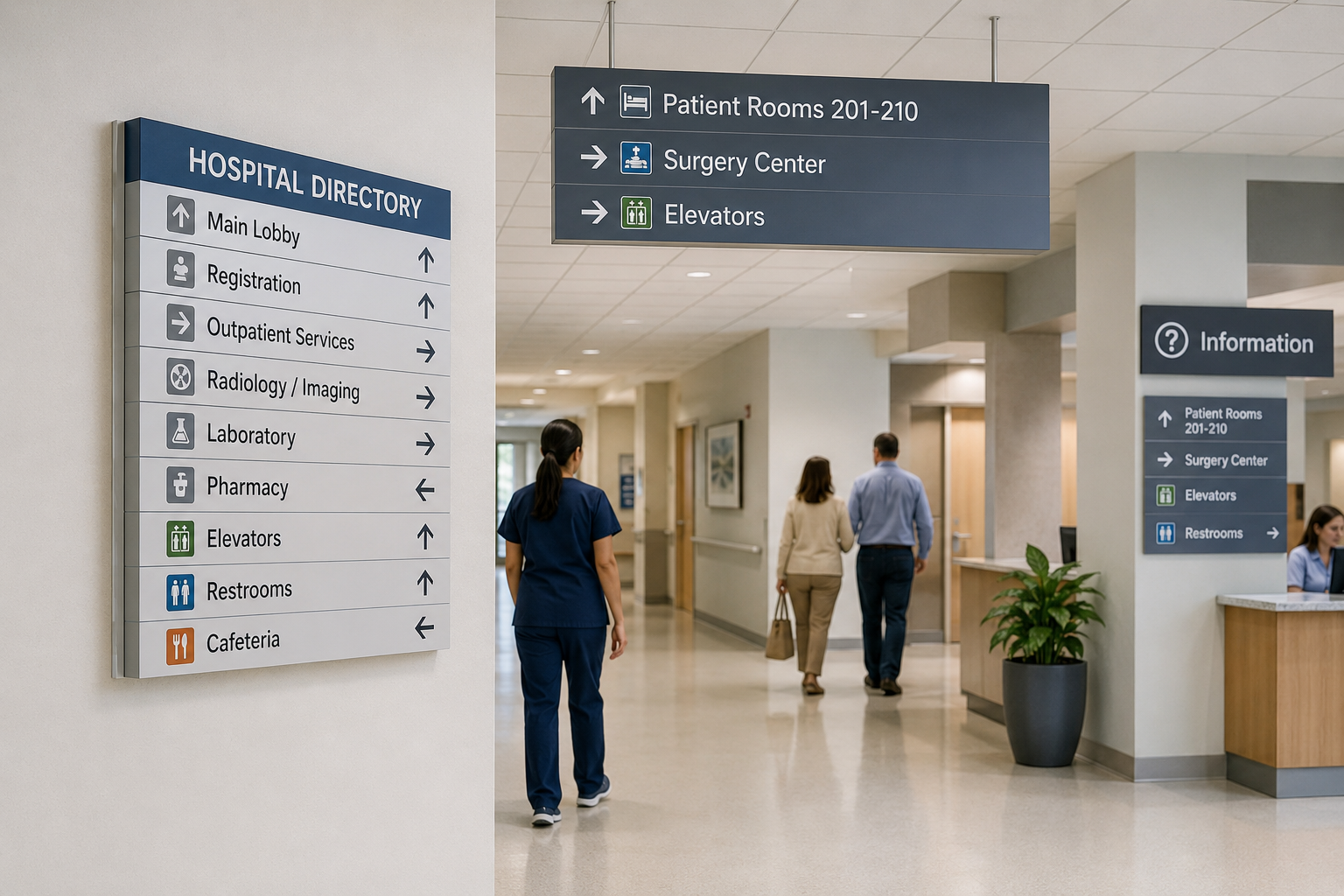
Static hospital wayfinding is the traditional approach of fixed signs, boards, and maps placed throughout the building to guide patients, visitors, and staff to the right departments, rooms, and facilities. In a hospital with multiple floors and dozens of departments, clear signage makes all the difference between finding your way and wandering around lost. Unlike digital systems, static signs stay the same until someone physically updates or replaces them; no real-time changes, just consistent directions. And that's part of the appeal: even with all the digital options available today, plenty of hospitals still stick with static signage simply because it's straightforward, dependable, and easy to maintain.
Common types of static signage
Directional Signs
These signs help people find the right way to reach different areas of the hospital.
Example: Signs showing directions to the emergency room, ICU, or laboratory.
Department Signs
These signs identify different hospital departments so visitors can easily recognise the location.
Example: A sign displaying “Cardiology Department” or “Radiology Department.”
Room Identification Signs
These signs show the name or number of a specific room or area inside the hospital.
Example: A sign saying “Room 205” or “Patient Consultation Room.”
Floor Directory Boards
These boards provide information about departments and facilities available on each floor.
Example: A board near an elevator showing “1st Floor: Reception, 2nd Floor: Surgery, 3rd Floor: ICU.”
Wayfinding Maps
These maps give a visual view of the hospital layout to help people understand where different locations are.
Example: A hospital map showing entrances, departments, parking, and elevators.
Entrance and Exit Signs
These signs clearly mark entry and exit points to help people move around the hospital easily.
Example: Signs showing “Main Entrance” or “Emergency Exit.”
Safety and Instruction Signs
These signs provide important safety information and instructions for patients and visitors.
Example: “No Entry,” “Fire Exit,” or “Hand Sanitising Station” signs.
Accessibility Signs
These signs help people with disabilities find accessible facilities and routes inside the hospital.
Example: Signs showing wheelchair-accessible entrances, ramps, or accessible restrooms.
Restroom and Amenity Signs
These signs help visitors locate common facilities and services within the hospital.
Example: Signs pointing to restrooms, cafeterias, waiting areas, or parking.
Benefits of static wayfinding
Static wayfinding is really helpful in hospitals because it gives patients, visitors, and staff directions. This makes it easy for people to find their way without needing any special tools or help from technicians. Some key benefits of wayfinding include:
Simple and easy to understand
Cost-effective and budget-friendly
Reliable without power or internet
Low maintenance and easy to manage
Works well for fixed locations
Easy for all visitors to follow
Reduces confusion and navigation stress
Provides clear and consistent directions
Limitations of traditional signage
Static hospital wayfinding is easy to understand. It does not break down often. It is also simple to keep it working properly. However, static hospital wayfinding may not work well for every hospital. When hospitals get really big and have many rooms and corridors, static wayfinding can be confusing. The old signs that people are used to can make it harder to find your way. Here are some of the problems with static hospital wayfinding.
Hard to Update
When a hospital makes changes to its layout or moves a department to a different place, the old signs have to be replaced by hand. This takes a lot of time and effort. Costs more money.
No Real-Time Information
The old signs in hospitals cannot show information as it happens. They cannot tell visitors about rooms that have been moved for a time, areas that are closed, or special routes to follow in an emergency.
Limited Navigation Support
The old signs in hospitals can only point people in the right direction. They cannot give visitors step-by-step directions, so people can still get lost in hospitals like Hospital.
Language Barriers
If the signs in a hospital are in one language, visitors who speak a different language may have a hard time understanding what the signs say. Hospital signs need to be in multiple languages.
Limited Accessibility Features
The old signs in a hospital have features that help people with disabilities, like Braille. They cannot give people voice directions, interactive maps, or personalised navigation to help people with different needs navigate the hospital.
Best use cases
Best use cases mean the situations or places where a solution works most effectively. For static hospital wayfinding, it refers to the areas where fixed signs provide clear, reliable, and easy-to-follow directions. Some of the best use cases of static hospital wayfinding include:
Permanent Departments
Static signs work well for departments that stay in the same location for a long time, such as Emergency, Pharmacy, and Radiology. They help visitors easily find these important areas.
Room Identification
Room signs help patients and visitors quickly locate specific rooms, such as consultation rooms, patient rooms, and offices. They provide clear and simple directions inside the hospital.
Entrances, Exits, and Common Areas
Static signage is useful for marking entrances, exits, elevators, restrooms, waiting areas, and cafeterias. These signs help people move around the hospital without confusion.
Safety and Emergency Information
Safety signs provide important instructions, such as emergency exits, fire escape routes, and restricted areas. They remain visible at all times and do not require power or internet.Parking Areas and Building Entrances
Signs in parking areas and building entrances help visitors find the correct entry points, drop-off zones, and hospital facilities easily. They create a smoother arrival experience for patients and visitors.
What Is Digital Hospital Wayfinding?
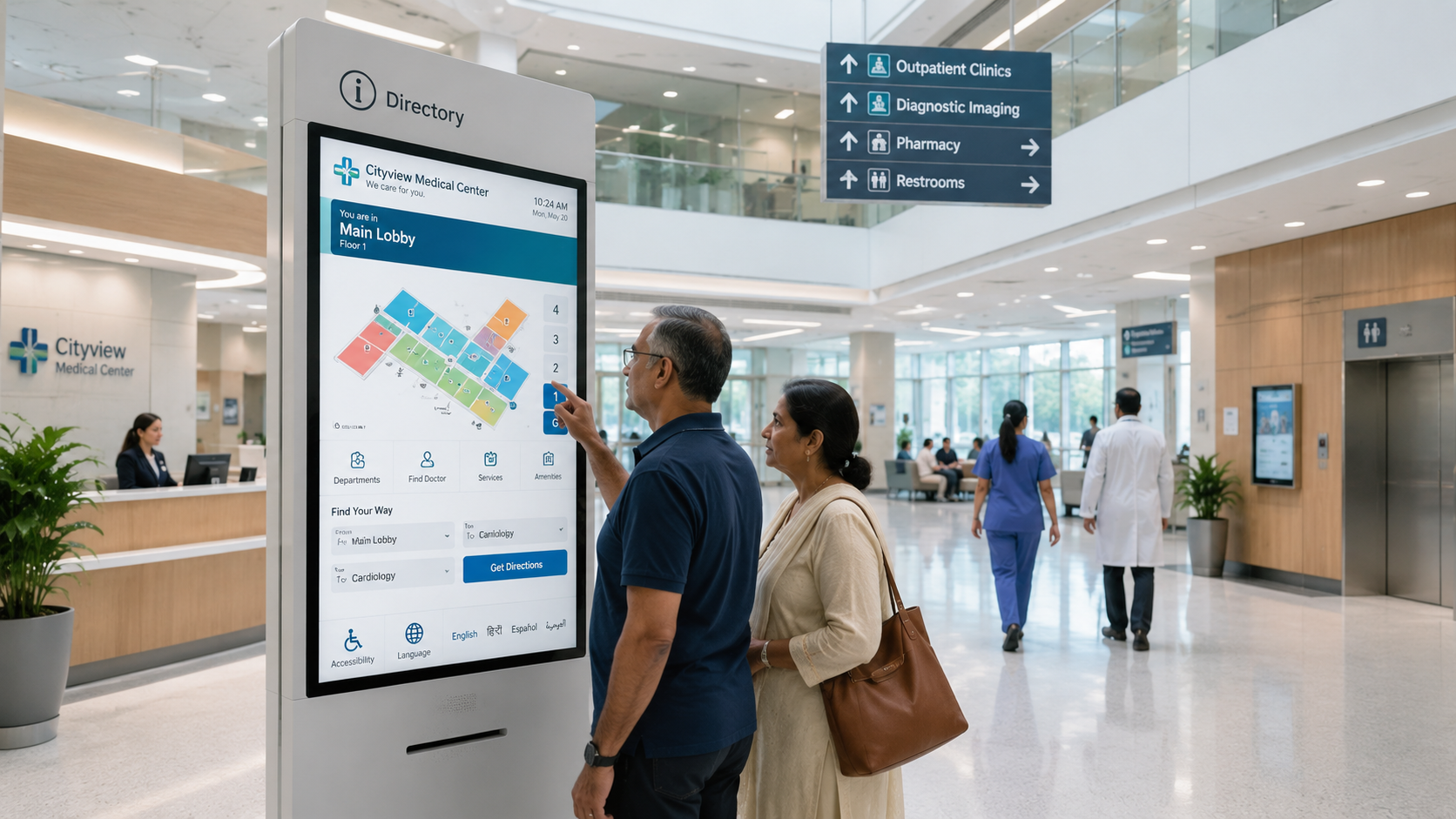
Digital hospital wayfinding takes a more modern approach, using interactive kiosks, touchscreen displays, mobile apps, and digital maps that help patients, visitors, and staff find their way around. In a large hospital spread across multiple buildings and floors, that kind of step-by-step, real-time guidance makes a real difference. And unlike static signs, digital systems can be updated in minutes, not months a department moves, a route changes, or new info needs to go out, it's done almost instantly. That flexibility is what makes the experience feel smoother and more personal, reducing confusion and helping the whole hospital run more efficiently.
Types of digital wayfinding solutions
Digital navigation tools use up-to-date technology to help patients, visitors, and workers move around hospitals easily. These tools are different from signs. They can show maps, give real-time directions, and offer personal help. This makes the hospital experience quicker and calmer.
Some of the common types of digital hospital navigation tools include:
Interactive Wayfinding Kiosks
You know those touchscreen devices they have in hospitals. They are really helpful when you need to find something. You can use them to search for departments, rooms, and facilities. They show you maps and give you step-by-step directions on how to get where you want to go.Example: A touchscreen kiosk at the hospital entrance showing directions to the “Emergency Department, Cardiology, and Laboratory.”
Mobile Wayfinding Apps
There are also apps for your phone that can help you navigate through the hospital. These apps use maps and give you guided directions.Example: A patient uses a hospital app to find the fastest route from the parking area to the doctor’s consultation room.
Indoor Positioning Systems and Bluetooth Beacons
These are technologies that help the hospital's digital wayfinding systems figure out where you are inside the hospital. They make sure you get directions.Example: A visitor receives turn-by-turn directions from the hospital lobby to the ICU using their smartphone.
AI-Powered Voice Assistants
Some hospitals have systems that use artificial intelligence and voice technology to give you spoken directions. This means you do not have to look at a screen to find your way.Example: A visitor asks, “How do I reach the pharmacy?” and the voice assistant provides step-by-step guidance.
Augmented Reality Navigation
This is a cool way to navigate through the hospital. It uses your smartphone camera to show you information and guide you to where you want to go. Example: A visitor points their phone camera around the hospital and sees digital arrows guiding them to the MRI department.
Challenges to Consider Before Implementing Digital Hospital Wayfinding
Digital hospital wayfinding is a thing because it helps people find their way around hospitals. Hospitals have to think about some problems before they start using it. Things like how much it costs and who will take care of it are important. The kind of technology that is needed and what people want to get from it also matter.
Some of the problems with digital hospital wayfinding are:
Higher Initial Cost
When you want to set up a hospital wayfinding system, you have to buy software, digital screens, kiosks, sensors, and get everything installed. This costs a lot of money at the beginning, which is more than what you would pay for traditional signs that do not change.
Ongoing Maintenance
Digital wayfinding systems need to be updated. Checked all the time. You also need to have people who can fix them if something goes wrong. This is necessary to make sure digital hospital wayfinding systems keep working
Dependence on Power and Connectivity
Digital hospital wayfinding systems need electricity, internet, and network connections to work. If there is a power outage or a problem with the internet, digital hospital wayfinding systems will not be available.
Complex Implementation
To set up digital hospital wayfinding in a hospital, you have to plan carefully, set up the technology, and make sure it works with the hospital's existing systems.
Frequent Layout Changes
Hospitals often move departments, rooms, or change the way you get to places. Digital hospital wayfinding maps and navigation information need to be updated all the time so they are accurate.
Technology Adoption Challenges
Some people who visit the hospital, like people or those who are not good with technology, may find digital hospital wayfinding tools hard to use. They might prefer signs that do not change.
Data Privacy Concerns
Digital hospital wayfinding systems can collect information about where visitors are. So hospitals have to make sure they protect this information and handle it safely.
Accessibility and Language Support
Digital hospital wayfinding systems need features such as voice guidance, multilingual support, and navigation that is easy for everyone to use. This is necessary to support all patients and visitors who use hospital wayfinding systems.
Best use cases
Digital hospital wayfinding is really useful in healthcare places where it's hard to find the way because the buildings are big and lots of people come in. Things change a lot. It helps hospitals give directions, make the visit better for people, and make it easier for patients, guests, and workers to get around.
The following are some of the situations where digital hospital wayfinding can offer the most help:
Large Hospitals and Multi-Building Campuses
When a hospital has buildings and floors, digital wayfinding is really helpful. It gives visitors accurate directions, which is what a big campus like that needs. Digital wayfinding helps people find their way around the hospital.
Hospitals with Frequent Layout Changes
Sometimes departments in a hospital move to a different place. Sometimes spaces get. Routes change. Instead of putting up new signs every time, hospitals can update a digital map in just a few minutes. This is very useful for hospitals.
High-Volume Hospitals
Some hospitals are very busy with a lot of people walking around. Digital wayfinding helps cut down on confusion. It keeps visitors moving and does not bother the staff with a lot of questions about directions. The staff can focus on things when digital wayfinding is used in High-Volume Hospitals.
Emergency and Critical Care Facilities
In emergency departments and trauma centres, every second is important. Digital wayfinding helps people get to the place quickly. It gives them real-time directions, which means they get up-to-date information. Digital wayfinding is very important in Emergency and Critical Care Facilities.
Hospitals with Diverse Patient Needs
Hospitals have patients with needs. Some patients speak languages. Some patients need voice guidance. Some patients need routes that're easy to access. Digital wayfinding can adapt to these needs. It does not expect all patients to navigate the hospital in the same way, which is good for Hospitals with Diverse Patient Needs.
Data-Driven Healthcare Facilities
Hospitals that use navigation data can see how people actually move around the building. This helps them understand how to make the hospital better. They can use this information to improve the layout and services of the hospital over time. Digital wayfinding is useful for Data-Driven Healthcare Facilities because it provides them with information.
Key Factors to Consider Before Choosing a Wayfinding System
Choosing the wayfinding system for a hospital depends on several important factors. Every hospital has different needs, budgets, and patient requirements. Thinking about these factors can help hospitals choose a solution that makes navigation easier and supports growth. Before making a decision, think about the following factors:
Hospital Size and Layout
Hospitals that're large and have many buildings and departments often get the most benefit from digital wayfinding. Smaller hospitals that have layouts may only need static signage design.
Budget and Total Cost of Ownership
Look at both the cost and the long-term costs for installation, maintenance, updates, and repairs before choosing a system.
Frequency of Departmental Changes
If departments or rooms move around often, digital wayfinding makes it much easier to update than replacing signs.
Patient Demographics
Think about who comes to the hospital. Hospitals that have patients from other countries or people with disabilities may get a lot of help from digital features like voice guidance and languages other than English.
Accessibility Requirements
Pick a wayfinding system that helps everyone by having routes, Braille, voice guidance, and other features that make it easy for all people.
IT Infrastructure
Digital wayfinding needs an internet connection, a network, and technical support to work well. Static signage does not need much technology.
Future Scalability
If the hospital wants to grow and add buildings or departments, pick a wayfinding system that can grow with the hospital.
Regulatory Compliance
Make sure the wayfinding system follows the rules and standards for healthcare and accessibility. This helps make sure all visitors have a welcoming experience.
The Future of Hospital Wayfinding: What's Next
Hospital wayfinding is changing. It is moving away from signs and maps. Now we have connected navigation systems. New technologies like artificial intelligence and mobile technology are helping hospitals. They are making it easier for patients, visitors, and staff to find their way. As hospitals get bigger and more complex, these new systems will help people navigate.
AI-Powered Navigation
Artificial intelligence is helping hospitals. It looks at how visitors behave, what appointments they have, and what is happening in real time. Then it tells them the way to get where they are going. Hospital wayfinding is getting better because of this. We have personalized directions now. We also have support for languages. If an elevator or corridor is closed, the system can tell us a different way to go.
Indoor Positioning Systems
These systems use technologies such as Bluetooth beacons, Wi-Fi, and RFID tags. They help figure out where someone is inside a building. This is useful because GPS does not work inside. Now we can navigate buildings in real time. We can also track where things are.
Mobile-First Wayfinding
More hospitals are letting patients use their smartphones to find their way around. They do not have to use kiosks or printed maps. We have QR codes now. We can get directions that are linked to our appointments. We can even get help finding a parking spot.. The system can give us step-by-step directions.
Voice-Guided Navigation
This is helpful for people who cannot see well. It is also helpful for visitors and people who are not familiar with the hospital. Hospital wayfinding is getting better because of voice assistance. We have voice guidance in languages now. We can navigate without using our hands.
Digital Twins
A digital twin is like a copy of a hospital. It is a replica. We can use it to see how patients move around. We can make the layout better. We can even find out where it gets crowded. We can make wayfinding better before we make any physical changes.
Smart Hospital Ecosystems
In the future, wayfinding will work with systems. It will work with appointment systems and electronic health records. It will work with parking management and visitor management. It will even work with signs and emergency response systems. All of these systems will work together to make an experience for patients.
Predictive Visitor Analytics
Hospitals can look at how people move. They can see where it gets crowded. They can make signs better. They can even make sure they have staff. They have to be careful with people's private information. They have to follow the rules when they collect and analyze data. Hospital wayfinding is getting better because of this.
Frequently Asked Questions
What are the different types of hospital wayfinding systems?
Hospitals typically use a mix of static signs, digital kiosks, mobile navigation apps, interactive maps, and voice-guided navigation, often combining several for better coverage.
How do hospitals help patients who get lost?
Between clear signage, information desks, digital kiosks, maps, and staff on hand to help, hospitals give patients and visitors several ways to find where they're going.
What percentage of hospital visitors ask for directions?
Studies suggest that 30% to 50% of hospital visitors ask for directions at some point, not surprising, given how large and complex most hospitals are.
Is digital signage better than static signage in hospitals?
Each has its strengths. Digital works well for real-time updates and interactive navigation, while static signs are simple, reliable, and don't depend on power. Most hospitals get the best results combining both.
What makes a good hospital wayfinding system?
A good system is easy to understand, clearly visible, and accessible to everyone — helping people reach their destination with as little confusion as possible.
How much does hospital wayfinding cost to implement?
It really depends on the hospital's size and the system chosen. Static signage tends to be more budget-friendly upfront, while digital wayfinding costs more initially but offers greater flexibility down the line.
Conclusion
In the end, there is not one wayfinding solution that's best for every hospital. Static wayfinding is simple, reliable, and cheap, making it a good choice for hospitals or places where directions do not change often. Digital wayfinding gives navigation, up-to-date information, and features that help people with disabilities. These are very helpful in hospitals with complicated designs and changes that happen regularly.
The best choice depends on the hospital's size, the money available, and what patients need. What the hospital plans to do in the future. Many places in healthcare get the results by using both static and digital wayfinding systems. When they work together, they give directions, make the experience better for visitors, take some work off the staff, and let patients and visitors get where they need to go with less worry and more confidence.
