

How Wayfinding Signage Improves Customer Experience in Commercial Spaces
A positive customer experience begins long before a customer speaks with a salesperson or completes a purchase. In a commercial space, people form impressions from the moment they enter. If they can quickly understand where they are, where they need to go, and how to get there, the environment feels more welcoming and professional.
This is where wayfinding signage plays an important role. Clear signs can reduce confusion, support customer navigation, and help visitors move confidently through retail stores, office buildings, shopping centres, hotels, healthcare facilities, and other commercial environments.
Effective commercial wayfinding is not simply about placing directional signs around a property. It involves planning information, sign placement, visual hierarchy, accessibility, and the complete visitor journey. When these elements work together, wayfinding solutions can improve usability while reinforcing the identity of a business.
What Is Wayfinding Signage?
Wayfinding signage is a coordinated system of signs and visual information that helps people navigate a physical environment. It tells visitors where they are, where they need to go, and which route they should take.
A complete wayfinding system may include:
Directional signs
Building and room identification
Entrance and exit signs
Floor directories
Maps and location information
Parking and traffic signs
Digital navigation displays
Accessibility information
Unlike individual signs, a well-planned wayfinding system connects these elements into one consistent navigation experience.
Why Commercial Wayfinding Matters
Commercial spaces can become difficult to navigate when they contain multiple entrances, floors, departments, stores, offices, or facilities. Visitors may become frustrated if important destinations are difficult to find.
Effective commercial wayfinding addresses this problem by providing relevant information at the right location.
Good wayfinding can help businesses:
Reduce visitor confusion
Improve movement through the space
Make important destinations easier to find
Create a more professional environment
Support accessibility
Strengthen brand consistency
Improve the overall visitor experience
The goal is not to add more signs. The goal is to provide clear information when people need to make a navigation decision.
How Wayfinding Signage Improves Customer Experience
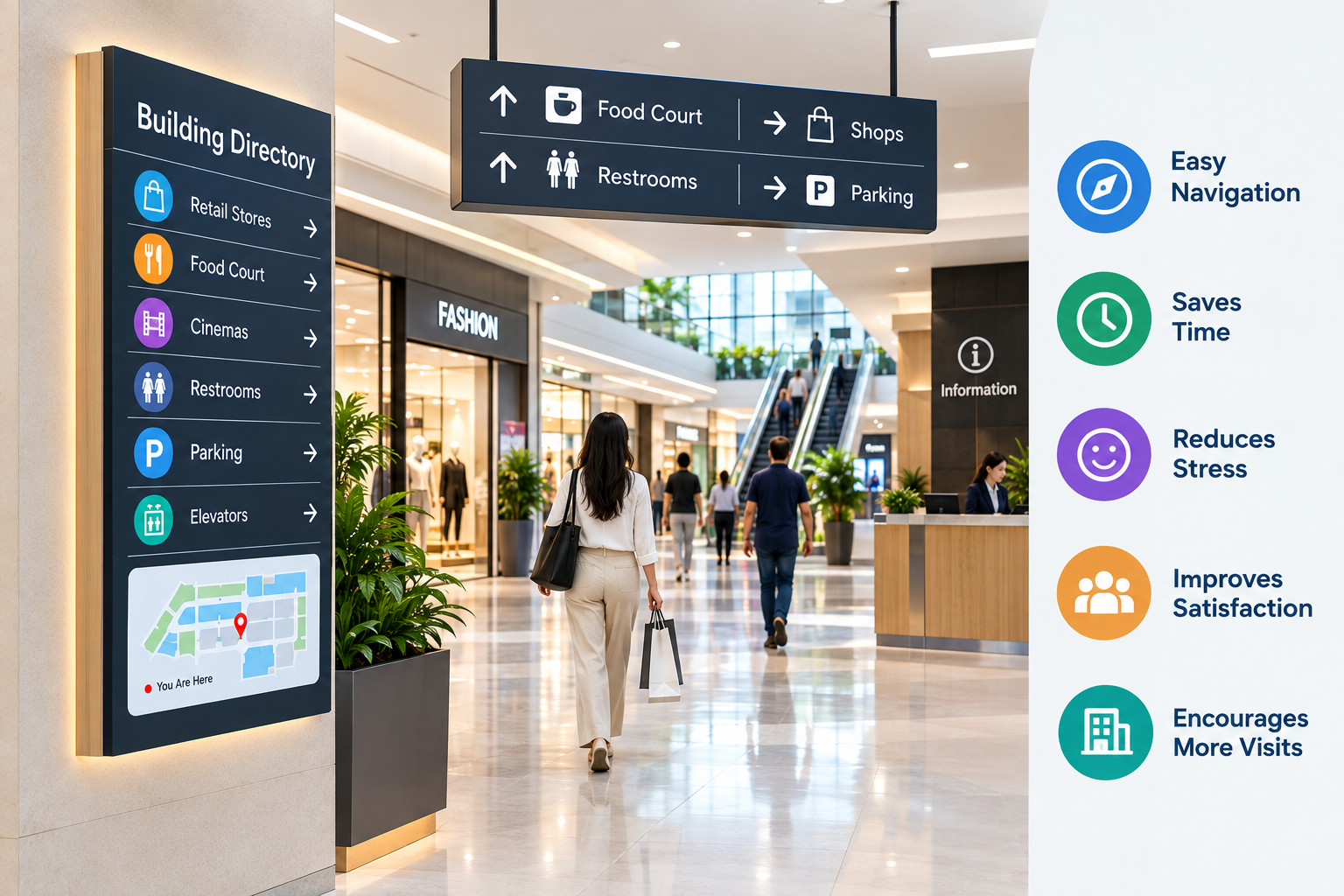
1. Reduces Confusion and Frustration
When visitors cannot find an entrance, store, office, restroom, reception area, or other destination, uncertainty can quickly affect their perception of a business.
Clear directional signage provides simple instructions that help people move forward without repeatedly asking for assistance.
A well-designed system can make navigation feel natural rather than becoming something visitors have to think about.
2. Makes Navigation Faster
Customers generally want to reach their destination efficiently. Unclear routes, missing signs, or inconsistent information can result in unnecessary walking and backtracking.
Strategically positioned directional signs can guide people at key decision points, such as intersections, entrances, elevators, stairways, and corridors.
This makes customer navigation more predictable and efficient.
3. Creates a More Welcoming Environment
Visitors feel more comfortable when they understand their surroundings. Clear signage communicates that a business has considered the needs of its customers.
For example, a shopping centre with consistent store directories and directional signs creates a more organized experience than one where visitors have to search for information.
This contributes directly to a stronger visitor experience.
4. Supports Brand Identity
Wayfinding does not have to look purely functional. Signage can incorporate a business's typography, colours, symbols, materials, and visual style.
When these elements are applied consistently, wayfinding becomes part of the overall environment and reinforces brand recognition.
The result is a navigation system that is both practical and visually aligned with the business.
5. Helps Customers Find More Destinations
Good wayfinding can encourage visitors to explore a commercial environment with greater confidence.
In retail and mixed-use spaces, clear directories and directional information can help customers discover stores, amenities, facilities, and services they may otherwise overlook.
This makes wayfinding solutions valuable not only for navigation but also for improving how people interact with a space.
Key Elements of Effective Commercial Wayfinding
Successful wayfinding depends on several connected design and planning decisions.
Clear and Simple Information
Visitors should be able to understand a sign quickly. Short wording, familiar terminology, recognizable symbols, and logical information hierarchy make signs easier to use.
Strategic Sign Placement
Signs should appear where people need to make decisions. Placing a sign too early, too late, or away from the natural walking route can reduce its usefulness.
Consistent Design
Typography, colours, symbols, arrows, terminology, and layouts should remain consistent throughout the environment. Consistency allows visitors to recognize navigation information quickly.
Appropriate Visibility
Sign size, contrast, lighting, viewing distance, and mounting height should match the environment. A sign that is technically present but difficult to see does not provide effective guidance.
Accessibility
Wayfinding should consider the needs of different users. Legible text, appropriate contrast, recognizable symbols, accessible placement, and suitable tactile or other accessibility features can make navigation more inclusive.
Wayfinding Across Different Commercial Spaces
Different environments require different approaches to navigation.
Retail and Shopping Centres
Retail environments often need directories, store identification, parking signs, entrances, exits, and promotional information. Effective wayfinding helps customers move between different areas without confusion.
Corporate Offices
Office buildings may require reception identification, floor directories, meeting-room signs, department identification, and visitor directions.
Healthcare Facilities
Healthcare environments require particularly clear navigation because patients and visitors may be unfamiliar with the facility and may already be under stress. Well-planned wayfinding can help people locate departments, consultation rooms, reception areas, elevators, and other essential destinations.
Mixed-Use and Large Commercial Developments
Large developments may require multiple layers of navigation. Consistent navigation systems can connect parking areas, entrances, buildings, floors, and key destinations.
The Role of Digital Wayfinding
Technology is creating new possibilities for commercial navigation. Digital displays can provide maps, directories, real-time information, and interactive navigation in environments where information changes frequently.
However, digital wayfinding does not necessarily replace physical signs.
A strong approach may combine:
Permanent directional signs
Printed maps and directories
Digital displays
Interactive navigation systems
Accessibility-focused signage
The right combination depends on the complexity of the environment, visitor requirements, available technology, and content that needs to be updated.
Common Wayfinding Mistakes to Avoid
Even attractive signage can fail when the overall navigation system has not been properly planned.
Common problems include:
Too much information on one sign
Inconsistent terminology
Poor sign placement
Confusing arrows or symbols
Insufficient contrast
Missing information at decision points
Signs that are difficult to see
Inconsistent branding
Relying entirely on digital displays
Adding signs without considering the complete visitor journey
A professional approach evaluates how people actually move through the environment rather than designing each sign independently.
How to Plan an Effective Wayfinding System
Businesses can improve their signage strategy by following a structured process.
Understand the Environment
Identify entrances, exits, destinations, circulation routes, parking areas, elevators, stairs, and major decision points.
Understand the Audience
Consider who will use the space and what information they need. Customers, employees, guests, and first-time visitors may navigate differently.
Create an Information Hierarchy
Prioritize the most important information so visitors can identify their destination and route quickly.
Design a Consistent Signage System
Use consistent typography, colours, symbols, arrows, terminology, and layouts throughout the environment.
Test the Experience
Observe how unfamiliar users navigate the space. Their behaviour can reveal confusing routes, missing information, or poorly positioned signs.
Why Professional Wayfinding Solutions Matter
Professional wayfinding solutions go beyond designing individual signs. They consider the entire customer journey, from arrival to destination.
A well-planned system combines information architecture, environmental conditions, visual communication, accessibility, and sign placement. This helps businesses create environments that are easier to understand and more comfortable to navigate.
For complex commercial spaces, professional planning can also reduce unnecessary signage and prevent inconsistent or conflicting directions.
The Future of Commercial Wayfinding
The future of commercial wayfinding is moving toward more connected and user-focused experiences. Digital directories, interactive maps, real-time information, smart navigation, and accessible design are becoming increasingly relevant in larger commercial environments.
At the same time, physical wayfinding signage remains essential because visitors often need immediate, reliable information without interacting with a device.
The most effective approach is therefore not necessarily the most technological one. It is the approach that provides the right information, in the right format, at the right moment.
Frequently Asked Questions
1. What is wayfinding signage?
Wayfinding signage is a coordinated system of signs that helps visitors understand their location, identify destinations, and follow the correct route.
2. How does wayfinding improve customer experience?
Wayfinding improves customer experience by reducing confusion, making navigation easier, supporting accessibility, and helping visitors reach destinations confidently.
3. What is commercial wayfinding?
Commercial wayfinding is the planning and use of navigation signage within business environments such as offices, retail spaces, hotels, shopping centres, and mixed-use developments.
4. What are examples of directional signage?
Examples include arrows, entrance and exit signs, floor directories, parking signs, room identification, maps, and signs directing visitors toward specific destinations.
5. Can digital technology improve wayfinding?
Yes. Digital displays and interactive maps can provide flexible information, real-time updates, directories, and advanced navigation in suitable commercial environments.
6. What makes wayfinding signage effective?
Effective wayfinding signage is clear, visible, consistent, accessible, and positioned where visitors need information to make navigation decisions.
Conclusion
Effective wayfinding signage can have a significant impact on how customers experience a commercial space. Clear information helps reduce confusion, supports customer navigation, improves accessibility, and allows visitors to move through an environment with greater confidence.
Successfulcommercial wayfinding combines strategic placement, simple information, consistent design, appropriate visibility, and an understanding of how people actually move through a space. Physical directional signage can also be complemented by digital displays and modern navigation systems where they provide genuine value.
Ultimately, the best wayfinding solutions are not simply attractive signs. They are carefully planned systems that make commercial environments easier to understand, easier to navigate, and more welcoming for every visitor.
