

LED vs Digital Signage: Which Solution Is Best for Your Business?
Choosing the right signage is more than selecting an attractive display. For modern businesses, signage needs to capture attention, communicate information clearly, support branding, and sometimes help visitors navigate complex spaces. This is why LED and digital signage have become increasingly important across retail, hospitality, corporate, healthcare, transportation, and commercial environments.
The answer depends on your business objectives, location, audience, content requirements, budget, and long-term communication strategy. LED displays can provide exceptional visibility and visual impact, while digital signage offers flexibility and dynamic communication. In many environments, combining different signage formats can create a more effective overall experience.
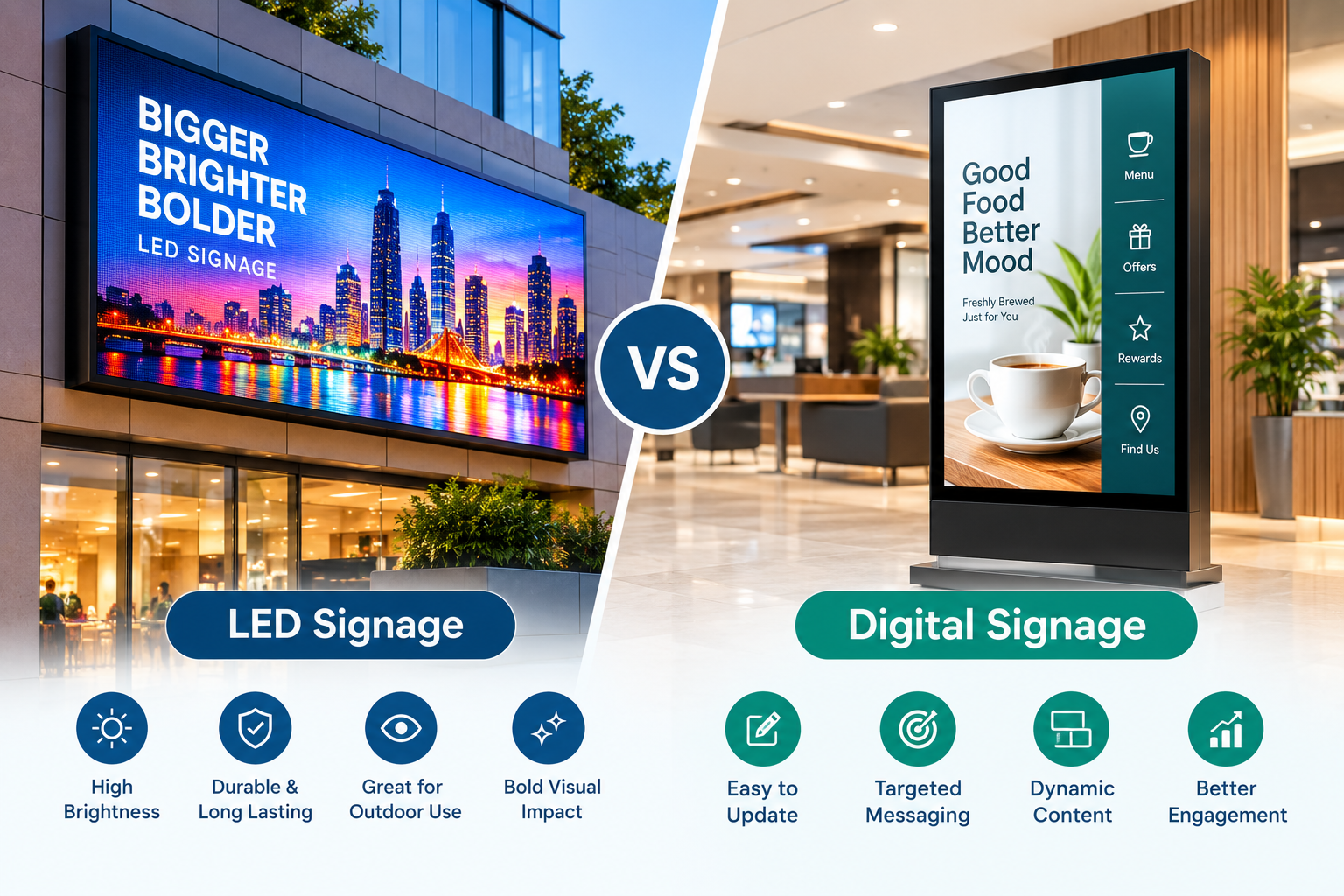
What Is LED Signage?
LED signage uses light-emitting diodes to create illuminated signs and displays. Because LEDs can provide high brightness and strong visibility, they are particularly effective when signs need to attract attention from a distance or remain visible in changing lighting conditions.
LED solutions range from illuminated business signs to large programmable displays. They are commonly used for storefronts, commercial buildings, event venues, retail environments, transportation areas, and other high-traffic locations.
Benefits of LED Signage
LED signage can offer several advantages:
High visibility during the day and night
Strong visual impact
Excellent brightness for outdoor environments
Long operating life when properly maintained
Suitable for large-format applications
Effective for branding and promotional messaging
Flexible options for commercial environments
For businesses where visibility and brand recognition are priorities, LED signage can be a practical and powerful choice.
What Is Digital Signage?
Digital signage uses electronic displays to present content such as text, images, videos, announcements, menus, maps, promotions, and real-time information.
Unlike static signage, digital displays allow businesses to change their messages without physically replacing printed graphics. This difference is particularly important when comparing digital vs. static wayfinding, where digital solutions can provide greater flexibility for changing information and visitor communication. Depending on the system, content can also be scheduled, updated, and managed remotely.
This flexibility makes digital signage particularly useful in environments where information changes frequently.
Benefits of Digital Signage
Businesses can use digital signage to:
Display multiple messages on one screen
Update information quickly
Present videos and animations
Promote products and services
Display schedules and announcements
Provide visitor information
Support interactive experiences
Manage content across multiple locations
For organizations that regularly update their communication, digital signage can provide greater flexibility than permanent signage.
LED vs Digital Signage: What Is the Difference?
LED and digital signage are not always completely separate technologies. Many modern digital displays use LED-based screens. However, businesses often use the terms to distinguish between high-brightness LED display systems and screen-based digital communication solutions.
The practical difference usually comes down to purpose, content, viewing environment, and flexibility.
| Feature | LED Signage | Digital Signage |
|---|---|---|
| Primary strength | Visibility and visual impact | Flexible communication |
| Content | Graphics, text, animations, and video (depending on system) | Text, images, video, maps, and multimedia |
| Content updates | Depends on configuration and control system | Usually quick and flexible |
| Outdoor use | Excellent with outdoor-rated specifications | Possible with suitable commercial displays |
| Indoor use | Yes | Excellent |
| Best suited for | Branding, visibility, and large displays | Information, promotions, and communication |
| Content flexibility | Moderate to high | Very high |
Rather than asking which technology is universally better, businesses should identify which solution best supports their specific communication and customer experience goals.
When Should You Choose LED Signage?
LED signage is often the better option when your business needs strong visibility.
For example, a retail outlet located beside a busy road may benefit from a highly visible illuminated sign that can be recognized from a distance. Large commercial buildings, venues, and outdoor facilities may also require bright displays that remain noticeable in different lighting conditions.
Choose LED signage when you prioritize:
Long-distance visibility
Outdoor exposure
Brand recognition
Large-format communication
Day-and-night visibility
High-impact visual displays
Before installation, businesses should consider viewing distance, brightness, weather exposure, mounting requirements, power consumption, and maintenance.
When Is Digital Signage a Better Choice?
Digital signage is often more suitable when your business communicates changing information.
A hotel, for example, might use displays for event schedules, restaurant promotions, guest announcements, and directions. A corporate facility could use screens for meeting-room information, employee announcements, visitor information, and internal communications.
Digital signage can be particularly useful for:
Retail stores
Hotels and hospitality spaces
Restaurants
Corporate offices
Healthcare facilities
Educational institutions
Shopping centres
Transportation hubs
Events and exhibitions
The ability to update content without replacing physical graphics makes digital displays valuable for dynamic environments.
How Wayfinding Fits Into Modern Signage
Effective signage is not only about advertising or brand visibility. It also helps people understand where they are, where they need to go, and how to get there.
This is where wayfinding becomes important.
A well-designed wayfinding signage system can include directional signs, maps, directories, room identification, entrances, exits, and other navigation elements. These signs create a logical information system that helps visitors move confidently through a building or property.
In larger or more complex environments, digital displays can complement physical wayfinding by providing interactive maps, real-time information, or changing directions.
The Role of Directional Signs
Directional signs should provide information at the moment people need to make a decision. Their placement, wording, typography, symbols, contrast, and visibility all influence how quickly users understand the information.
Effective wayfinding considers the complete visitor journey rather than treating every sign as an individual element.
Combining LED, Digital, and Physical Signage
Businesses do not always have to choose between LED and digital solutions.
A comprehensive signage strategy can combine technologies according to the needs of each area.
For example:
Exterior: LED signage can establish strong brand visibility and help people identify the property.
Entrance: Branded signage can clearly identify the building or facility.
Interior: Permanent wayfinding signs can provide reliable directions.
Reception areas: Digital displays can communicate changing information.
Complex navigation points: Digital directories or interactive navigation systems can supplement physical wayfinding.
This approach creates a more consistent visitor experience while giving each signage format a clear purpose.
How to Choose the Right Signage Solution
Choosing the right signage depends on where it will be used, what information it needs to communicate, and how often that information changes. Consider these key factors before making a decision:
Location: Consider indoor or outdoor conditions, lighting, weather, and viewing distance.
Purpose: Decide whether the sign is for branding, advertising, information, or wayfinding.
Content: Choose digital signage when messages change frequently.
Visibility: Consider brightness, size, contrast, and viewing distance.
Audience: Make information simple and easy for visitors to understand.
Navigation: Use wayfinding signage and directional signs where guidance is needed.
Budget: Consider installation, maintenance, energy use, and future costs.
Branding: Keep the signage design consistent with your visual identity.
Why Professional Signage Design Matters
Effective signage requires more than attractive graphics. Signage design and installation should consider viewing distance, information hierarchy, placement, readability, accessibility, environmental conditions, and brand consistency.
Professional planning can also identify important decision points where visitors need directional information.
For complex commercial environments, integrating digital display solutions, physical signs, and navigation systems can create a clearer and more cohesive experience.
A professional signage strategy should also consider how signs work together across the entire environment. Consistent typography, symbols, colours, terminology, and placement can make information easier to recognize and understand.
The Future of Signage and Wayfinding
Modern signage and wayfinding are becoming increasingly focused on experience rather than simple visual communication. Digital displays, smart technologies, interactive navigation, real-time information, and accessibility are influencing how businesses design physical environments.
At the same time, traditional signage remains valuable for permanent information and dependable navigation.
The future is therefore unlikely to be about replacing every physical sign with a screen. Instead, successful businesses will use the right combination of technologies to deliver information when and where people need it.
Frequently Asked Questions
1. What is the difference between LED signage and digital signage?
LED signage focuses on brightness and visibility, while digital signage provides flexible, changeable content such as videos, promotions, and announcements.
2. Is LED signage suitable for outdoor use?
Yes. LED signage is highly visible outdoors and can work well in different lighting conditions when properly designed and installed.
3. What is wayfinding signage?
Wayfinding signage helps people navigate buildings and spaces using directional signs, maps, directories, and identification signs.
4. Can digital signage be used for wayfinding?
Yes. Digital signage can provide maps, directories, interactive navigation, and real-time directions.
5. How does signage improve visitor navigation?
Clear and well-positioned signage helps visitors quickly understand where they are and find their destination.
6. Why is professional signage design important?
Professional signage design ensures signs are clear, readable, properly positioned, and consistent with the surrounding environment.
Conclusion
Choosing between LED signage and digital signagedepends on your business goals, location, audience, and communication needs. LED signage is ideal for strong visibility and brand impact, while digital signage offers flexibility for changing content and engaging displays.
A successful signage strategy can also include wayfinding signage, directional signs, and other navigation systems to help visitors move through a space with ease. By combining the right technology with thoughtful signage design and installation, businesses can create a professional environment that improves visibility, communication, and visitor navigation.
