

How AI and Digital Technology Are Changing Wayfinding Systems
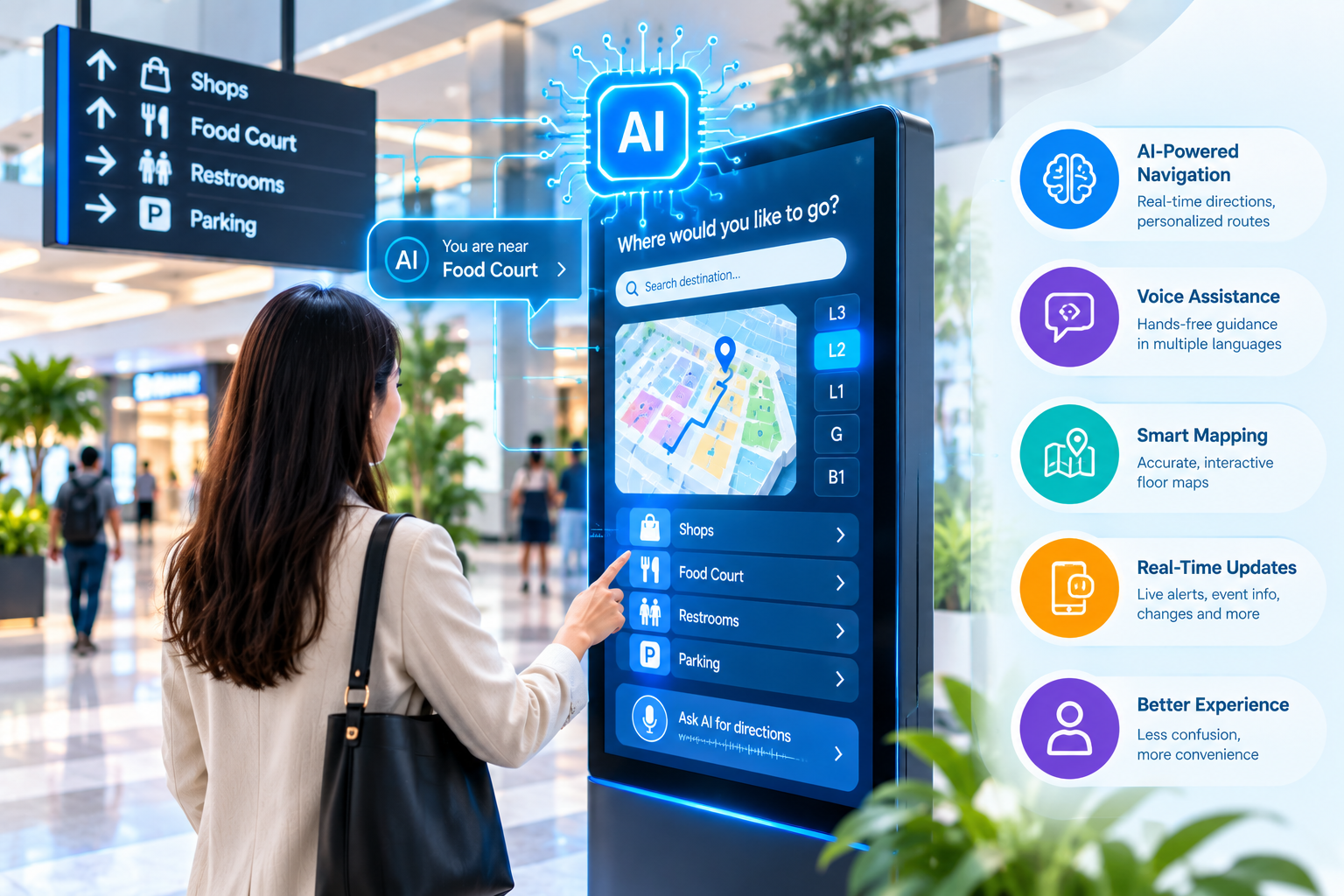
Finding your way through a large hospital, airport, shopping centre, corporate campus, or mixed-use development can be challenging when visitors are unfamiliar with the environment. Traditional signs remain essential, but modern wayfinding systems are increasingly using artificial intelligence and digital technology to make navigation more intelligent, responsive, and user-focused.
AI wayfinding and digital wayfinding can help people find destinations, understand routes, access real-time information, and navigate complex spaces with greater confidence. Instead of relying only on fixed directional signs, businesses and public facilities can combine physical signage with interactive maps, digital displays, location-based technology, and smart navigation systems.
The goal is not to replace traditional wayfinding. It is to create a more connected navigation experience that provides the right information at the right moment.
What Is AI Wayfinding?
AI wayfinding refers to the use of artificial intelligence to improve how people navigate physical environments. AI can analyze information about locations, routes, destinations, user behaviour, and changing conditions to support more intelligent navigation.
Depending on the technology used, AI-powered systems may help users:
- Find the fastest or most suitable route
- Identify nearby facilities
- Receive personalized directions
- Navigate complex buildings
- Understand changing routes
- Access information through conversational interfaces
- Receive location-specific recommendations
For example, in a large healthcare facility, an AI-enabled navigation system could help a visitor locate a specific department while considering the building layout and available routes.
AI does not necessarily mean that every sign becomes intelligent. Instead, it can work behind the scenes to make existing navigation systems more responsive and useful.
What Is Digital Wayfinding?
Digital wayfinding uses digital technology to provide navigation information through screens, mobile devices, interactive kiosks, websites, applications, or other connected interfaces.
Unlike static signage, digital systems can change information quickly. They can display maps, directions, announcements, schedules, destinations, and other relevant information based on the environment.
Common examples include:
- Interactive directories
- Digital maps
- Touchscreen wayfinding kiosks
- Mobile navigation applications
- Digital signage
- QR-enabled navigation
- Indoor navigation platforms
- Real-time route information
These digital wayfinding solutions can be particularly useful in environments where destinations, routes, or information change frequently.
How AI and Digital Technology Are Transforming Wayfinding
Technology is changing wayfinding from a static sign-based system into a more connected visitor experience.
Real-Time Navigation
Traditional signs provide fixed information. Digital systems can respond to changing conditions. For example, if a particular entrance is temporarily closed, a digital navigation system can direct visitors toward an alternative route. This can be particularly valuable in airports, hospitals, campuses, shopping centres, and large commercial developments. See how this plays out in practice in our comparison of digital vs. static hospital wayfinding.
Smarter Route Recommendations
AI can support route selection by considering different factors rather than simply showing a destination. Depending on the system, route recommendations may account for distance, accessibility requirements, building entrances, temporary closures, congestion, user preferences, and available facilities — creating a more useful navigation experience than simply displaying a static map.
Interactive Navigation
Interactive navigation allows visitors to actively search for destinations instead of relying entirely on fixed signs. An interactive kiosk, for example, could allow a visitor to search for a store, department, meeting room, restaurant, or facility and receive step-by-step directions — especially helpful in large environments with multiple possible destinations.
Location-Based Technology
Location-based technology can connect navigation information with a user's approximate position. Depending on the implementation, technologies such as Bluetooth beacons, Wi-Fi positioning, QR codes, GPS, or other indoor positioning technologies can help determine where users are within an environment, allowing systems to provide more relevant directions.
Integration With Digital Signage
AI and digital wayfinding can also work alongside digital signage. A commercial building could use digital displays for building directories, event information, temporary route changes, visitor announcements, interactive maps, promotional information, and department or room directions — creating a connected environment where navigation and communication work together.
AI Wayfinding vs Traditional Wayfinding
Traditional wayfinding remains highly effective for permanent information. However, AI and digital technologies can add flexibility and personalization.
| Feature | Traditional Wayfinding | AI & Digital Wayfinding |
|---|---|---|
| Permanent directions | Excellent | Excellent |
| Real-time updates | Limited | Strong |
| Interactive maps | Limited | Available |
| Route personalization | Limited | Possible |
| Changing information | Manual updates | Faster updates |
| User interaction | Low | High |
| Complex navigation | Requires careful signage | Can provide dynamic guidance |
The most effective strategy is often a hybrid wayfinding system that combines physical signs with digital technology.
Benefits of Smart Wayfinding for Businesses
Implementing smart wayfinding can provide benefits beyond basic navigation.
Better Visitor Experience
Clear and responsive navigation can help visitors feel more confident when moving through unfamiliar environments.
Reduced Navigation Friction
When visitors can quickly find destinations, there is less need to stop, backtrack, or repeatedly ask staff for directions.
Greater Information Flexibility
Digital systems can update information without redesigning or replacing physical signs.
Improved Accessibility
Digital systems can provide route options and information that may support different accessibility requirements, depending on the technology and environment.
Valuable Visitor Insights
Some digital platforms can provide anonymized usage data that helps organizations understand frequently searched destinations and potential navigation problems, subject to appropriate privacy practices.
Where AI Wayfinding Can Make the Biggest Difference
AI and digital navigation can be particularly valuable in large or complex environments.
Hospitals
Hospitals often contain multiple departments, buildings, floors, entrances, and specialized facilities. Digital navigation can help patients and visitors locate destinations more efficiently.
Airports
Airports can use digital navigation to connect terminals, gates, security areas, lounges, baggage facilities, and other destinations.
Shopping Centres
Retail environments can use interactive directories and digital maps to help customers locate stores, restaurants, amenities, and parking areas.
Corporate Campuses
Large corporate facilities can use smart navigation to guide employees, visitors, and contractors between buildings and departments.
Educational Campuses
Universities and large schools can use digital maps and navigation systems to help students and visitors find classrooms, offices, libraries, and other facilities.
Challenges to Consider Before Implementing AI Wayfinding
Technology can improve navigation, but it should not be adopted simply because it is new. Businesses should consider:
- Building layout and complexity
- Accuracy of location data
- Accessibility requirements
- Technology infrastructure
- Maintenance and software updates
- User privacy
- Staff training
- Integration with existing signage
- Cost and long-term scalability
A digital system that provides inaccurate directions can create more frustration than a well-designed physical sign. For this reason, technology should support a clearly planned wayfinding strategy rather than replace good information architecture and signage design.
How to Build an Effective Digital Wayfinding Strategy
A successful implementation should begin with the environment and visitor journey.
Map the Visitor Journey
Identify how people enter, move through, and leave the space.
Identify Navigation Challenges
Find areas where visitors commonly stop, become confused, or ask staff for assistance.
Define the Right Technology
Choose digital displays, interactive kiosks, mobile navigation, location-based technology, or AI features based on actual requirements.
Connect Digital and Physical Signs
Ensure digital directions and physical wayfinding systems use consistent terminology, symbols, colours, and destination names.
Test With Real Users
Test navigation with people unfamiliar with the environment. Their feedback can reveal issues that may not be visible to people who know the building well.
The Future of AI and Digital Wayfinding
The future of AI wayfinding is likely to become more personalized, connected, and responsive. AI assistants, real-time information, indoor navigation, interactive maps, and smart building technologies can work together to provide more contextual guidance.
However, physical signage will continue to play an important role. Visitors should not always need a smartphone or digital device to find their way.
The strongest future approach is therefore likely to be a combination of smart wayfinding, digital technology, and thoughtfully designed physical signage.
Frequently Asked Questions
What is AI wayfinding?
AI wayfinding uses artificial intelligence to support smarter navigation by analyzing routes, locations, changing conditions, and other relevant information.
What is digital wayfinding?
Digital wayfinding uses screens, interactive maps, mobile platforms, kiosks, and other digital tools to help people navigate physical environments.
Can AI wayfinding work with traditional signage?
Yes. AI and digital systems can complement physical signs to create a more complete and reliable navigation experience.
Where is digital wayfinding most useful?
It is particularly useful in complex environments such as hospitals, airports, shopping centres, corporate campuses, universities, and large commercial developments.
How does location-based technology support wayfinding?
It can help identify a user's approximate position and provide more relevant navigation information based on their location.
Is AI wayfinding better than traditional signage?
Not necessarily. AI provides flexibility and dynamic guidance, while physical signage offers reliable, immediate information. A hybrid approach is often most effective.
Conclusion
AI and digital technology are changing how businesses and public spaces approach wayfinding systems. From interactive maps and real-time information to location-based technology, smart navigation systems, and AI-powered route recommendations, modern solutions can make complex environments easier to understand and navigate.
Effective wayfinding is not simply about adding technology. The most successful digital wayfinding solutions combine intelligent technology with clear information, thoughtful planning, accessible design, and reliable physical signage.
For businesses, the opportunity is to build navigation experiences that are not only smarter but also more intuitive and useful. By combining AI wayfinding, digital wayfinding, physical signage, and user-focused design, organizations can create environments where visitors spend less time figuring out where to go and more time confidently engaging with the space.
