

How Wayfinding Signage for Hotels Improves Guest Experience and Navigation
A hotel experience begins long before a guest reaches the room. From entering the property and finding the reception desk to locating elevators, restaurants, meeting rooms, restrooms, and amenities, every movement should feel intuitive. This is where wayfinding signage for hotels plays an important role.
Effective hotel wayfinding does more than point guests in the right direction. It creates a sense of confidence, reduces confusion, supports accessibility, and contributes to the overall character of the property. Whether it is a boutique hotel, luxury resort, business hotel, or large hospitality complex, a well-planned signage system can make navigation feel effortless.
What Is Wayfinding Signage for Hotels?
Wayfinding signage is a coordinated system of visual cues that helps people understand where they are, where they need to go, and how to get there.
In a hotel environment, this can include:
| ✓Directional signs for guest rooms and facilities | ✓Restroom identification signs |
| ✓Lobby and reception signage | ✓Emergency and safety signage |
| ✓Elevator and floor identification signs | ✓Digital navigation displays |
| ✓Restaurant and lounge signs | |
| ✓Meeting and conference room signs | |
| ✓Parking and entrance signage |
Unlike individual signs placed independently, professional hotel wayfinding design considers the entire guest journey. Signs are positioned according to movement patterns, decision points, sightlines, architectural features, and the needs of different types of visitors.
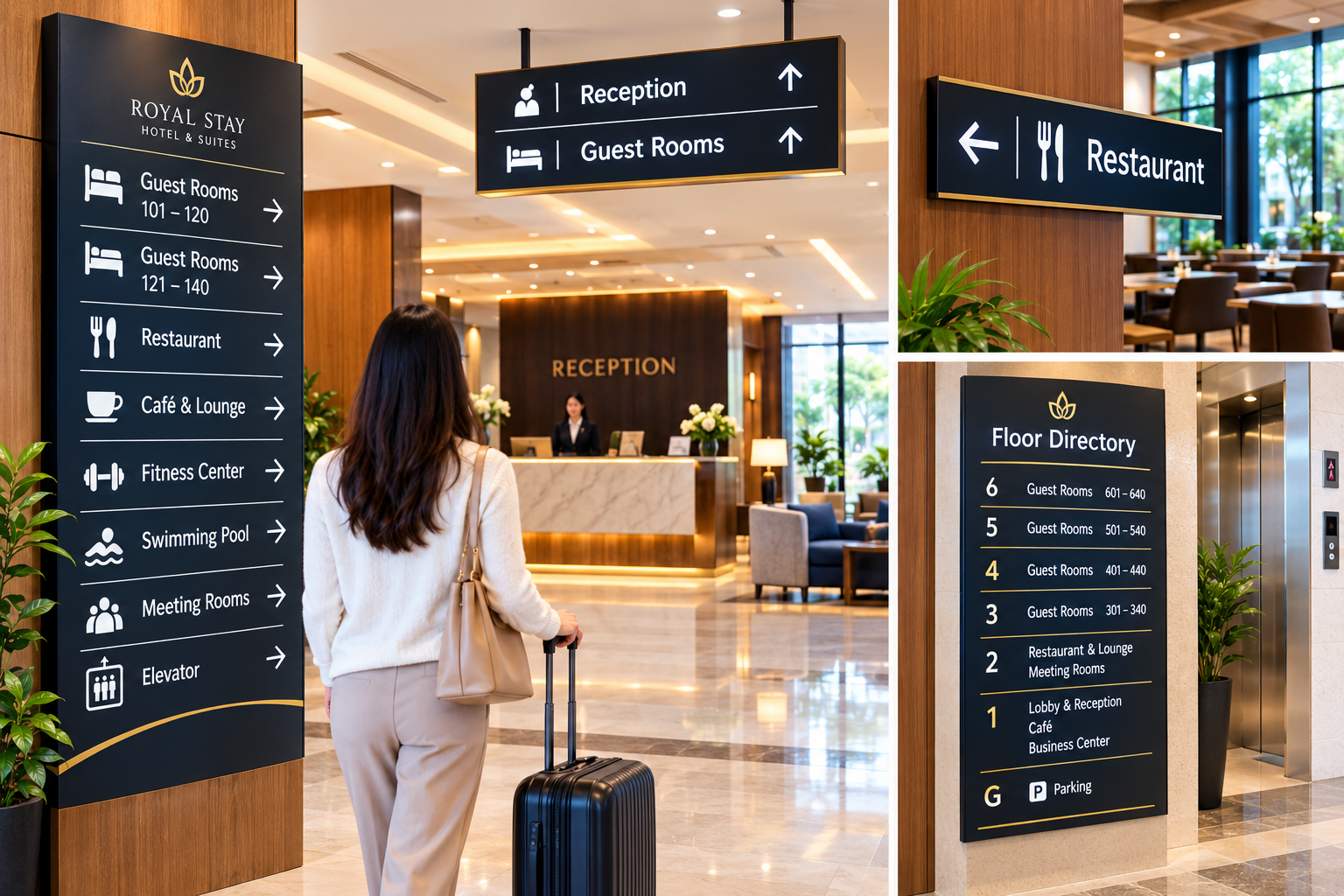
A hotel experience begins long before a guest reaches the room. From entering the property and finding the reception desk to locating elevators, restaurants, meeting rooms, restrooms, and amenities, every movement should feel intuitive. This is where wayfinding signage for hotels plays an important role.
Effective hotel wayfinding does more than point guests in the right direction. It creates a sense of confidence, reduces confusion, supports accessibility, and contributes to the overall character of the property. Whether it is a boutique hotel, luxury resort, business hotel, or large hospitality complex, a well-planned signage system can make navigation feel effortless.
What Is Wayfinding Signage for Hotels?
Wayfinding signage is a coordinated system of visual cues that helps people understand where they are, where they need to go, and how to get there.
In a hotel environment, this can include:
- Directional signs for guest rooms and facilities
- Lobby and reception signage
- Elevator and floor identification signs
- Restaurant and lounge signs
- Meeting and conference room signs
- Parking and entrance signage
- Restroom identification signs
- Emergency and safety signage
- Digital navigation displays
Unlike individual signs placed independently, professional hotel wayfinding design considers the entire guest journey. Signs are positioned according to movement patterns, decision points, sightlines, architectural features, and the needs of different types of visitors.
Why Hotel Wayfinding Matters for Guest Experience
Guests should not have to repeatedly stop and ask, "Where is my room?" or "How do I get to the restaurant?" Clear navigation allows visitors to move through the property with greater independence and confidence.
Reduces Guest Confusion
Hotels can have complex layouts with multiple floors, wings, entrances, elevators, restaurants, spas, pools, and event spaces. Without clear directional information, even an attractive property can become difficult to navigate. Strategically placed hotel navigation signage provides information at the right moment, helping guests make decisions before confusion occurs.
Creates a Better First Impression
The first few minutes inside a hotel can influence how guests perceive the property. Well-designed signage communicates organization and attention to detail. Premium materials, carefully selected typography, appropriate icons, and consistent visual language can also reinforce the hotel's identity. For luxury properties, signage becomes part of the interior environment rather than simply an information tool. This same principle shows up across commercial spaces more broadly — see how wayfinding signage improves customer experience in commercial spaces.
Supports a Smoother Guest Journey
A guest may move through several areas during one stay: Entrance → Reception → Elevator → Guest Room → Restaurant → Meeting Space → Amenities. Each transition creates a potential decision point. Effective hotel directional signs provide guidance where it matters most, helping guests understand their surroundings without interrupting their experience.
Key Elements of Effective Hotel Wayfinding Design
A successful wayfinding system combines functionality with thoughtful visual design.
Clear Information Hierarchy
Guests should immediately understand the most important information on a sign. Directional information should be easy to distinguish from supporting details — too much information can make a sign harder to scan, particularly in busy hotel environments.
Consistent Signage Language
A hotel should use a consistent system across different areas, including typography, icons and symbols, colors, arrows, materials, sign dimensions, mounting positions, and naming conventions. Consistency helps guests recognize and understand signs quickly.
Strategic Placement
Even a beautifully designed sign becomes ineffective if guests cannot see it at the right point. Professional wayfinding systems consider decision points such as intersections, elevator exits, corridors, entrances, and transitions between public and private areas.
Readability and Accessibility
Hotel signage should accommodate a diverse audience, including older visitors, international travelers, and people with different accessibility needs — from text size and visual contrast to tactile information, Braille, and accessible mounting heights.
How Directional Signage Improves Hotel Operations
Wayfinding is not only beneficial for guests. It can also support hotel teams. When guests can independently locate common destinations, front-desk staff may receive fewer routine navigation questions. Event attendees can also move more efficiently between conference rooms, dining areas, and other facilities.
This becomes particularly valuable for large hotels, resorts, convention properties, and mixed-use hospitality developments. A carefully planned directional signage system can therefore support both guest experience and operational efficiency.
Wayfinding for Different Types of Hotels
Every property has different navigation requirements.
Luxury Hotels
Luxury hotel wayfinding often needs to balance visibility with understated design. Materials, finishes, typography, and placement should complement the property's architecture and interior design.
Business Hotels
Business travelers often value speed and clarity. Signs should make it easy to locate meeting rooms, business centers, elevators, restaurants, and parking areas.
Resorts
Resorts can cover extensive areas, making navigation more complex. Hotel navigation signage may need to connect accommodation areas with pools, restaurants, spas, recreational facilities, and outdoor spaces.
Boutique Hotels
Boutique properties may have more distinctive architectural layouts. Their signage can become an extension of the brand identity while still maintaining clear guest navigation.
Digital Wayfinding and the Future of Hotel Navigation
Technology is expanding the possibilities for hospitality wayfinding. Digital displays, interactive kiosks, QR-enabled information, mobile navigation, and location-based technologies can complement physical signage.
For example, a digital wayfinding system could help a guest locate a restaurant, display walking directions, or provide information about hotel facilities. However, technology should enhance — not replace — the fundamentals of good wayfinding. Guests still benefit from clear physical signs, recognizable symbols, and consistent directional information. This mirrors what we've seen play out in healthcare settings too — see our breakdown of digital vs. static hospital wayfinding.
The emerging combination of physical wayfinding systems and digital navigation creates opportunities for hotels to deliver more connected guest experiences.
Common Hotel Wayfinding Mistakes to Avoid
Several issues can make hotel navigation unnecessarily difficult:
- Placing signs after rather than before decision points
- Using inconsistent terminology for the same destination
- Overloading signs with excessive information
- Choosing decorative typography that reduces readability
- Using unclear or inconsistent arrows
- Ignoring accessibility requirements
- Failing to consider sightlines and architectural obstructions
- Treating each sign as an individual design instead of part of one system
A professional signage strategy addresses these challenges during the planning and design stages.
How Professional Wayfinding Design Services Can Help
Developing an effective hotel signage system requires more than creating attractive signs. It involves understanding the architecture, visitor movement, brand identity, accessibility requirements, and operational needs of the property.
Professional wayfinding design services can help hospitality businesses with:
- Site and circulation analysis
- Guest journey mapping
- Signage hierarchy planning
- Signage location strategy
- Directional and identification signage
- Material and finish selection
- Typography and iconography
- Accessibility considerations
- Digital wayfinding integration
- Signage guidelines and documentation
Frequently Asked Questions
What is wayfinding signage for hotels?
Wayfinding signage for hotels is a coordinated system of directional, identification, informational, and other visual signs that helps guests navigate the property. It can guide visitors to rooms, elevators, restaurants, meeting spaces, amenities, parking areas, and other destinations.
Why is hotel wayfinding important for guest experience?
Hotel wayfinding helps guests understand where they are and where they need to go. Clear directional information can reduce confusion, support independent navigation, improve accessibility, and create a more organized experience throughout the property.
What types of signage are used for hotel wayfinding?
Common types include directional signs, room and destination identification signs, lobby signage, elevator and floor signs, restroom signs, parking signs, accessibility signage, safety signage, and digital navigation displays.
What should be considered when designing hotel wayfinding signage?
Important considerations include guest movement, decision points, sightlines, information hierarchy, readability, accessibility, architectural design, branding, materials, sign placement, and consistency across the property.
Can digital technology be integrated with hotel wayfinding?
Yes. Digital directories, interactive kiosks, QR-enabled information, mobile navigation, and location-based technologies can complement physical signage. The most effective solution depends on the property's size, layout, guest requirements, and operational needs.
Create a More Seamless Hotel Guest Journey
Great hospitality design is not only about what guests see — it is also about how effortlessly they move through a space.
Thoughtfully planned wayfinding signage for hotels can reduce uncertainty, improve navigation, reinforce brand identity, and create a more comfortable guest experience. From a boutique property to a large luxury resort, the right combination of hotel wayfinding design, directional signage, identification systems, and emerging digital technologies can transform the way visitors interact with the environment.
If your hotel is planning a new property, renovation, expansion, or signage upgrade, investing in a professionally planned wayfinding system can help create a more intuitive and memorable experience from arrival to departure.
