

How to Design an Effective Wayfinding System for Hotels
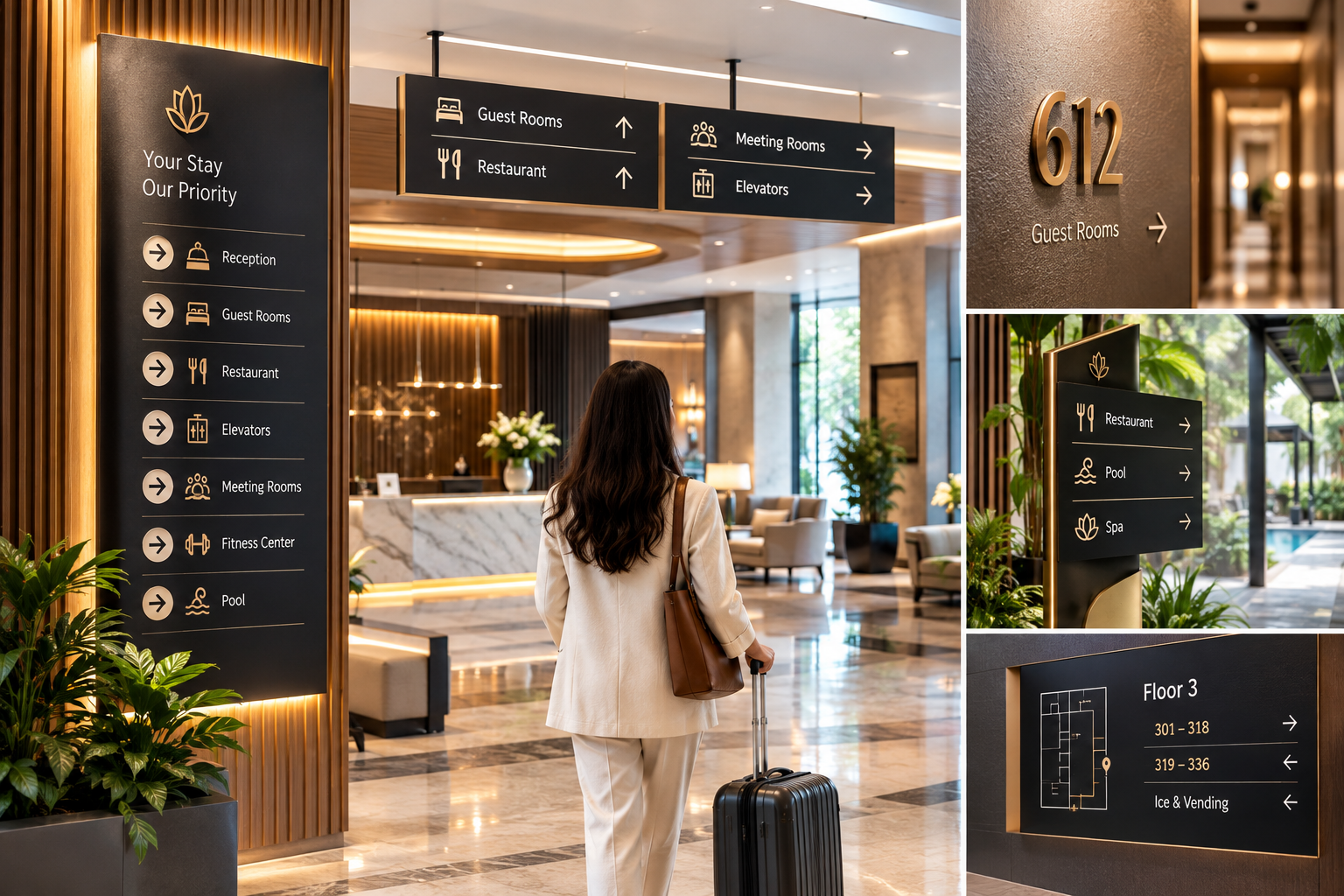
A hotel should feel easy to navigate from the moment a guest arrives. Finding reception, elevators, guest rooms, restaurants, meeting spaces, restrooms, parking, and amenities should not require repeated questions or guesswork. A thoughtfully designed hotel wayfinding system helps guests understand where they are, identify where they need to go, and follow a clear route to their destination.
Effective Hotel Wayfinding Design is more than installing a collection of signs. It combines information hierarchy, spatial planning, typography, symbols, colours, architectural cues, and strategically positioned signage to create a seamless Hotel Navigation experience. For modern hotels, resorts, and hospitality properties, professional Wayfinding Design Services can make navigation clearer while supporting the property's identity.
What Is a Hotel Wayfinding System?
A hotel wayfinding system is a coordinated set of physical and digital navigation elements that helps guests and staff move through a property efficiently.
It typically includes:
- Directional signage
- Identification signs
- Floor directories
- Room numbers
- Parking and arrival signs
- Regulatory and safety signs
- Maps and digital directories
- Accessible navigation features
The system should answer three fundamental questions for every visitor:
Where am I? Where do I need to go? How do I get there?
For example, a guest arriving at a large resort may follow a sequence of arrival signage, lobby directions, elevator information, floor identification, corridor signs, and room numbers. Each element should provide the right information at the right point in the journey.
Why Is Hotel Wayfinding Important?
Hotels can contain multiple floors, entrances, restaurants, conference facilities, recreational areas, parking zones, and service areas. Without a logical navigation system, even an attractive property can become difficult to understand.
Effective wayfinding can:
- Improve the overall guest experience
- Reduce confusion at decision points
- Make large properties easier to navigate
- Support accessibility and inclusive design
- Reduce the number of directions staff need to provide
- Reinforce the hotel's visual identity
- Improve communication during emergencies
- Create a more organised and welcoming environment
Good wayfinding should feel natural. Guests should notice the information they need without feeling overwhelmed by signage.
Types of Signage Used in Hotel Wayfinding
Different signs have different jobs. A successful Hotel Signage Design strategy uses several types of signage together.
Directional Signage
Directional Signage for Hotels guides guests toward specific destinations using arrows, text, numbers, and recognised symbols — for example, Reception →, Guest Rooms ←, Restaurant ↑, Swimming Pool →, Conference Centre ←, Parking ↓. Directional signs are particularly important at entrances, intersections, elevator lobbies, corridors, and other decision points.
Identification Signage
Identification signage confirms that a visitor has reached the correct location. Common applications include restaurant identification, spa and fitness centre signs, ballroom names, conference room signs, lobby identification, floor numbers, and guest room numbers. Clear identification supports confident Guest Navigation and reduces uncertainty after a visitor reaches a destination.
Informational and Directory Signage
Informational signs provide useful details about a facility or property. Directory signage is especially valuable in large hotels where several destinations may be located on the same floor — examples include floor directories, hotel maps, facility listings, restaurant timings, event information, and guest service information. A well-organised directory should present information in a clear hierarchy so visitors can quickly scan and understand it.
Regulatory and Safety Signage
Regulatory signage communicates rules, restrictions, and safety information. Emergency exits, fire equipment, no-smoking areas, restricted-access zones, and other safety-related locations may require specific signage that follows applicable building, fire-safety, accessibility, and local regulatory requirements.
Parking and Arrival Signage
The guest journey begins before entering the lobby. Parking and arrival signage can direct drivers toward hotel entrances, valet parking, self-parking, drop-off zones, accessible parking, loading areas, and exit routes. Clear Hotel Directional Signs in these areas can help prevent unnecessary circulation and make arrival smoother.
How to Design an Effective Hotel Wayfinding System
Designing an effective wayfinding system starts with understanding how people move through the property.
Map the Guest Journey
Begin by identifying common journeys rather than designing signs individually. For example:
Parking → Hotel Entrance → Reception → Elevator → Guest Room
Another journey could be:
Lobby → Restaurant → Restroom
For a business hotel:
Entrance → Reception → Conference Centre → Meeting Room
Mapping these journeys reveals where guests need information and where confusion is most likely to occur.
Identify Decision Points
Signs should appear where people need to make a navigation decision. Important decision points can include:
- Entrances and exits
- Lobby intersections
- Elevator lobbies
- Corridor junctions
- Staircases
- Parking areas
- Facility entrances
A sign placed too early may be forgotten, while one placed too late may leave guests uncertain about which direction to take.
Establish a Clear Information Hierarchy
Not every piece of information deserves equal visual emphasis. The destination should generally be easy to identify first, followed by supporting information such as floor numbers or secondary facilities. Typography, arrows, symbols, spacing, and contrast should work together to make information easy to scan.
Make Hotel Navigation Consistent
Consistency is one of the foundations of effective Hotel Wayfinding Design. The same visual language should be maintained across different sign categories, including:
- Typography
- Colours
- Arrows
- Icons
- Materials
- Sign dimensions
- Mounting positions
- Naming conventions
For example, if a hotel uses one style of arrow on lobby signs and a completely different style in corridors, guests may perceive them as unrelated information. A consistent system allows visitors to recognise navigation information quickly.
Design for Accessibility
Accessibility should be incorporated into wayfinding from the beginning. A hotel serves people with different abilities, ages, languages, and levels of familiarity with the environment. Depending on applicable standards and regulations, accessible wayfinding may include:
- High-contrast text
- Tactile lettering
- Braille
- Recognisable pictograms
- Accessible route information
- Appropriate sign placement
- Clear visual communication
Accessibility requirements vary by location and building type, so hotel signage should be developed with relevant regulations and standards in mind.
Combine Physical and Digital Wayfinding
Technology is adding new possibilities to Hotel Navigation. Hotels can complement physical signage with digital directories, interactive maps, QR-enabled information, mobile navigation, and indoor positioning technologies.
For example, a conference hotel could provide a digital map that allows an attendee to locate a meeting room while physical signs guide them along the route.
Digital technology should complement — not replace — the essential physical wayfinding system. Guests should still be able to navigate important areas without depending entirely on a smartphone.
Benefits of Professional Wayfinding Design Services
Large hospitality properties require more than attractive signs. Professional Wayfinding Design Services can consider the relationship between architecture, guest behaviour, branding, accessibility, and information flow. A specialist approach can help with:
- Guest journey mapping
- Signage hierarchy
- Sign placement
- Information planning
- Typography and iconography
- Accessibility
- Material selection
- Brand integration
- Digital wayfinding
- Signage implementation
This creates a connected system rather than a collection of unrelated signs.
Emerging Trends in Hotel Wayfinding
Modern wayfinding is becoming more adaptable and technology-enabled. Digital directories, interactive maps, smart displays, indoor navigation, and dynamic information systems are increasingly being considered alongside traditional signage.
Sustainability is also influencing Hotel Signage Design, with greater attention to durable materials, responsible production, modular systems, and designs that can be updated without replacing entire sign structures. At the same time, the fundamentals remain unchanged: information should be clear, timely, visible, accessible, and easy to understand.
Conclusion
An effective hotel wayfinding system turns a complex property into an environment that guests can understand intuitively. From Directional Signage for Hotels and room identification to directories, safety signs, accessibility features, and digital navigation, every element should contribute to one connected guest journey.
The strongest Hotel Wayfinding Design begins with real movement patterns, identifies key decision points, establishes a consistent visual language, and provides the right information at the right moment. When supported by professional Wayfinding Design Services, hotel signage can improve navigation, strengthen the guest experience, support accessibility, and complement the architectural character of the property.
Frequently Asked Questions
What is a hotel wayfinding system?
A hotel wayfinding system is a coordinated navigation framework that uses signage, symbols, maps, architectural cues, and digital tools to help guests and staff move around a hotel efficiently.
What are the main types of hotel signage?
The main types include directional signage, identification signage, informational and directory signs, regulatory and safety signage, room identification signs, parking signs, and digital wayfinding displays.
Where should hotel directional signs be placed?
Hotel directional signs should generally be positioned at important decision points, including entrances, lobby intersections, elevator areas, corridor junctions, parking areas, staircases, and routes to major amenities.
How does wayfinding improve the guest experience?
Clear wayfinding helps guests find destinations without unnecessary confusion or repeated requests for directions. It can make the property feel more intuitive, organised, welcoming, and accessible.
What makes effective Hotel Wayfinding Design?
Effective Hotel Wayfinding Design combines clear information hierarchy, readable typography, consistent symbols, appropriate sign placement, good visibility, accessibility, and integration with the hotel's architecture and brand identity.
Why is accessibility important in hotel wayfinding?
Accessible wayfinding helps more visitors navigate the property independently. Depending on applicable requirements, features may include tactile information, Braille, high contrast, clear pictograms, and accessible route indicators.
Can digital technology improve hotel navigation?
Yes. Interactive maps, digital directories, QR-enabled information, mobile navigation, and indoor positioning can supplement physical signage and provide additional navigation support.
Why should hotels invest in professional Wayfinding Design Services?
Professional Wayfinding Design Services can bring together guest journey planning, information hierarchy, signage placement, accessibility, branding, materials, and technology. This helps create a cohesive navigation system instead of isolated signs.
